
Ever embarked on a DIY furniture journey? Maybe you’ve felt this moment firsthand:
Everything’s locking, Allen key-ing, and coming together nicely. Until the pegs in step 12 don’t line up with the holes. Because the shelf in step 3 was put in upside down…
Frontline employee engagement is like a great, big IKEA assembly. Every step, screw, rod, and slat builds on each other toward one vision. If one aspect isn’t accounted for as part of a whole, then things will go well—until they don’t. Just like employees will seem happy—until they don’t. And you’re left looking back to figure out what, where, and when things went wrong.
The flipside? When you know what to account for, it’s actually pretty simple to build something amazing. That every team member will love being part of.
What Churn Costs (and Why Frontline Employee Engagement Efforts Pay)
A 2025 US Bureau of Labor Statistics report clocks an annual turnover rate of around 60% for the retail industry. With each exit costing up to $10,000—or on average, about one-fifth of the employee’s salary—in recruiting, onboarding, training, and lost productivity, that adds up fast.
Employee engagement for frontline teams is one of the soundest investments a retailer can make, in every sense of the word. By building a happier, more productive, and more deeply committed workforce, engagement helps reduce retail employee turnover. It makes basic dollars-and-cents sense.
What Does Frontline Worker Engagement Mean?
In a nutshell, successful employee engagement strategies in retail focus on helping frontline teams feel connected to their role, their colleagues, and the brand, giving purpose and meaning to their everyday work beyond it being “just a job.” They feel truly valued as part of the company, and create more value through their actions because of it.
So how exactly do you invest in it?
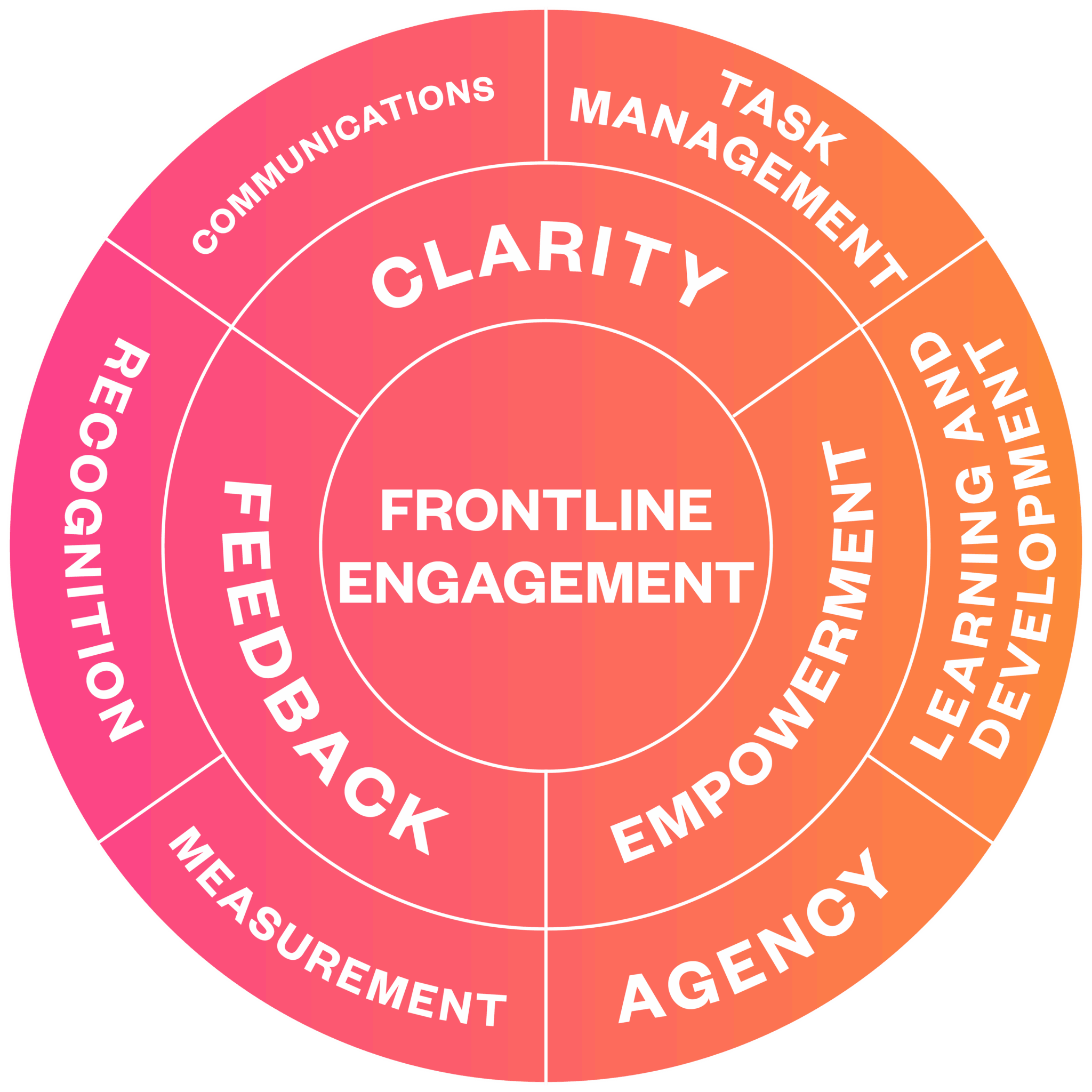
That’s where the Engagement Flywheel comes in, outlining key needs and focus areas for a thriving ecosystem of empowered, successful team members. Keep reading to learn why they’re so important and what you can do now to exponentially benefit your employees—and your business—from now on.
Frontline Employee Engagement Lever 1: Clarity
Taking care to architect processes and systems that provide clear understanding and upfront context is guaranteed to make up for itself—saving time, preventing mistakes, and powering productivity for frontline teams and everyone behind them.
The more clarity retail employees have around priorities, tasks, goals, directions, and their reasoning, the more supported and engaged they’ll feel from the get-go. And the fewer speedbumps they’ll meet on the road to getting things done.
Providing Clarity Through Communication
There’s no getting around that retail operations require a lot of communication. From HQ to the frontline, communication is an organization’s nervous system—signaling the what-to-dos, whys, whens, and wheres of every moving part.
So it’s not about managing the amount of communication. It’s about managing how overwhelmed employees can get from it. Lighting a path to whatever information they need, whenever they need it.
One of the most direct ways to put this in place is to organize communication channels by intention. Intent-based communication categorizes messages, resources, and documentation by what they’re meant to be used for. These typically fall into four categories for retailers:
- Evergreen: policy documents, training materials, product information
- Inspirational: messages from leadership, employee highlights
- Collaborative: spaces for sharing ideas, asking questions, having conversations
- Executional: directives, to-dos, time-sensitive instructions
This boosts retail employee engagement by providing understanding and supporting independence. Immediate context is given through the respective channel, and employees can quickly locate information by category.
Cadence is also a major factor in communications clarity and frontline worker engagement. Too much or too little communication can result in missed information, buried in a cascade of messages or slipped through the cracks. In a webinar on strengthening frontline teams, Zipline CEO and author of Stores Don’t Suck: The 5 Principles of Amazing Retail Communication, Melissa Wong, shared how to cut through ongoing communications “noise”:
“We’ve found the most effective solution to be a structured daily communication cadence. Rather than sending updates at random throughout the day, a [daily] bundle consolidates essential information into a single update at the start (or end) of each shift. So employees know when to check for updates and develop a consistent habit of reviewing information at predictable times.”
Meanwhile, when the VP of Innovation and Operations of Helzberg found too little communication resulted in little-to-no engagement, he solved for it with a strategic wedding-inspired cadence. Focused on providing clarity and building anticipation, he rolled out key details and resources leading up to a launch. And it worked! Employees not only got the information they needed, but felt genuinely excited about it.
Providing Clarity Through Task Management
When it comes to employee engagement for frontline teams, the benefits of clarity in task management go both ways. Because store employees and leadership alike know exactly what to work on, and can be proactive in accomplishing it.
For frontline teams, that means having their priorities and tasks clearly laid out, with simple routes for getting answers and information pertaining to them. For store managers and leadership, that means being able to easily assign and track tasks, have a bird’s eye view of what’s getting done, and jump in with coaching and clarification, if needed, in real time.
This sets everyone up for success, and fosters collaboration and support on the way to faster and tighter execution. The key is to centralize task management and communication. Because communication is what gives tasks clarity.
For example, an individual feed with daily priorities and assigned tasks helps teams hit the ground running. If tasks and communications are streamlined, they can ask a question about or comment on that task, straight away, no preamble needed. Relevant resources are attached or accessible right within that space—saving countless minutes and potential loss of focus from sifting through disconnected sources.
This made a huge difference for Festival Foods employees at all levels—to the tune of 93% employee readership, 90% execution, and an 86% reduction in in-store assessment time.
“You come in…and see what’s coming up for the day, and then as a leader I can go in and see what was accomplished the day before and what maybe is behind, and ask questions in that area,” said the Senior VP of Store Operations.
With the Market Store Director echoing, “I take a look at overdue tasks and communications that have been streaming into the store. I have a good idea of what I’m walking into, so that allows me to engage leadership in the store at a much higher level.”
Frontline Employee Engagement Lever 2: Empowerment
The word “empowerment” gets thrown around a lot, but its impact on frontline worker engagement goes far beyond buzz. When we talk about empowering retail teams, we mean making sure they feel valued and trusted as contributors, and part of something bigger than their individual role.
The Senior Retail Communications Leader at TravisMathew saw significant increases in frontline engagement—leveling readership and execution up to nearly 100%—directly from internal branding that showed employees they’re key to a larger vision. But there are many ways to empower and raise employee engagement for frontline teams.
Providing Empowerment Through Learning and Development
Knowledge is power, as they say. The most effective way for retail teams to build and retain knowledge is to couple it with action.
The more frontline employees have on-the-go access to the information and answers they need, the more they’ll learn, and be inclined to learn even more. Because what they’re learning can be directly applicable, and its solution can be immediately seen. Which translates to an immediate—and memorable—feeling of accomplishment.
Easy, thoughtful accessibility to learning and development support goes a long way in empowering and engaging employees, too. That support can be offered in a variety of ways, from task-associated resources to customized learning journeys based on roles and levels, from consolidated learning materials to instant answers through AI assistance. This facilitates independent learning and demonstrates how much their individual development is valued.
Want some practical tips? Watch our recent webinar on Launching Learning That Lasts for proven ways to build effective learning programs from three retail L&D experts.
Providing Empowerment Through Agency
Agency is essential to feeling truly empowered as an employee. And essential to agency is flexibility, autonomy, and control.
A lot of what we’ve covered supports the agency of frontline teams. Providing more upfront and overall clarity, the ability to quickly get answers and information, proactively learn, and know exactly what they need to do, how, and why, gives deeper understanding of the business and trust in decision making.
Just ask Visionworks, which saw a clear uptick in engagement and performance by giving employees clear processes and freed-up time to work on more impactful and creative initiatives.
“There’s transparency in what we’re doing and how we’re doing it, which empowers everyone to feel like they can be part of taking great care of patients, growing the business, helping people see great,” said their Director of Retail and Labor Operations.
Shift swapping has also come up time and again in conversations with retailers—so much that we built an integration for it with UKG. One of the top reasons hourly workers quit is lack of schedule flexibility, leaving retailers to continually play catch-up (refer back to What Churn Costs above). This integration lets frontline employees request shift swaps, covers, or pick up open shifts in Zipline—and managers to instantly approve or deny them, with every change syncing in real time in UKG.
So employees can have more control over their schedule, leadership can more easily manage shifts and ensure stores are covered, and frontline loyalty is nurtured through respect for their time and more agency over it.
Frontline Employee Engagement Lever 3: Feedback
The “Feedback Loop” is something we champion because it generates so much value for store teams, leadership, and the business as a whole. Frontline workers have a particularly critical vantage point for gathering and relaying feedback about customer experience and location-specific operations.
Yet another reason employee engagement for frontline teams is important. Engaged employees are more intrinsically motivated to take initiative and contribute to store success—including observing what’s working and providing solutions for what’s not. Here are some ways to provide feedback and keep that engagement strong.
Providing Feedback Through Recognition
Giving credit for a job well done is as powerful as it is simple. It shows an employee they’re seen as a contributor, appreciated for their skills or ideas, and acknowledged for their positive impact.
The key to actively fostering genuine, deep engagement through recognition is to keep it consistent, diverse, and forward-thinking. To show you see their ongoing work. That you’re noticing the big wins and the small improvements. To mix up private high-fives with public shout-outs. And to offer thoughtful commentary that shows an investment in their long-term growth.
There’s no one way to go about this. Rather, it’s more about making it easier to stay on top of tasks and communicate feedback in the moment. While celebrating successes and offering constructive support for actionable development.
Providing Feedback Through Measurement
Which brings us to the role of data-driven feedback and continuous, targeted, real-time tracking of individual and store performance. Things like:
- Operational health and overall store metrics
- Task progress and execution
- Employee engagement, like readership rates and learning
This gives an ongoing view of, and establishes a baseline for, what’s going well or needs improvement. So you can offer considered feedback with real substance, backed by real-world reporting and analytics. Meanwhile, employees feel more engaged with and connected to their work because they can see the impact it’s having.
“It’s looking at sales, traffic, execution, and being able to have a better understanding around levers of the business,” Melissa Wong emphasized when discussing the importance of real-time measurement for better execution—in conjunction with empowering employees through meaningful feedback.
“If you can build ongoing business updates with the materials and resources, and connect the what with the why and the how, people become better business owners…it’s helping people make better decisions for the business, which ultimately helps drive business results, and makes them feel like they matter more.”
Powering Frontline Employee Engagement From Within
As the Engagement Flywheel demonstrates, every aspect of frontline employee engagement is connected.
Clarity, feedback, trust, agency, learning and development, support for growth, and everything in between—it all works together and builds on each other to create an environment employees will love working in. And a company they’ll love working for.
Zipline’s centralized platform is designed to make this as easy, streamlined, and organic as possible. Interested in learning how? Book a demo for a guided tour and to tell us about what you need out of a retail operations solution.
Or just want more tips on keeping store teams happy and successful? Sign up for our newsletter to get them straight to your inbox.