Clinton Judy is one of the senior architects of Zipline’s conversational AI assistant, Zippy. Two years after Zippy was made available to customers, it now has MCP capabilities that allow it to reach beyond what was previously accessible through the Zipline platform.
We connected with Clinton to learn more about how Zippy came to be and how its MCP capabilities help frontline users access more information without spending more time on the Zipline platform.
This interview has been edited for clarity and brevity.
Hi Clinton. You worked closely on the initial development of Zippy. Tell us about Zippy’s origins.
Clinton: I’ve been very interested in the development of these large language models, going back to GPT-2 or 3. There was a moment where it seemed like they were getting pretty exciting. I was playing around with my own little RAG [Retrieval-Augmented Generation] system on my computer and thought, I would love to have something like this at Zipline. I talked to product managers here and got the go-ahead to put together a prototype. We had that prototype built and then we had Summer Camp, our big customer-facing event, where we showed the prototype as “here’s something we’re thinking of.”
There was a lot of excitement. We iterated on it and then launched six months after Summer Camp.
That’s very cool. I’m curious, where does Zippy’s name come from?
Clinton: I knew that [our CEO] was a big fan of squirrels. I was like, I need to give this thing a personality. So I said, it’s a flying squirrel, and his name is Zippy. That name stuck, and we’ve been calling it Zippy ever since.
Can you walk us through how having Zippy changes the experience for the frontline team?
Clinton: Our approach with Zippy from the very beginning is that Zippy knows what you know. It has access to what you have access to. If you can read it elsewhere in Zipline, a communication, a document, a resource in the resource library, Zippy is able to read that as well.
Zippy is almost like your work buddy sitting next to you that knows all the answers and can help you with what you need and get out of your way. It meets you where you are. Think of the employee that’s been at a store for over 10 years and they just know how everything works.
Zippy has new MCP capabilities. How does that work?
Clinton: Before MCP, Zippy was able to answer questions you have about anything in the resource library or in communications at Zipline. We had the ability for Zippy to call tools inside of Zipline to get real-time information on things like tasks you may have to do. MCP allows Zippy to call tools outside of Zipline, so Zippy has access to real-time information and can do things for you beyond [the Zipline platform].
Can you give us an example of what that looks like on the store floor?
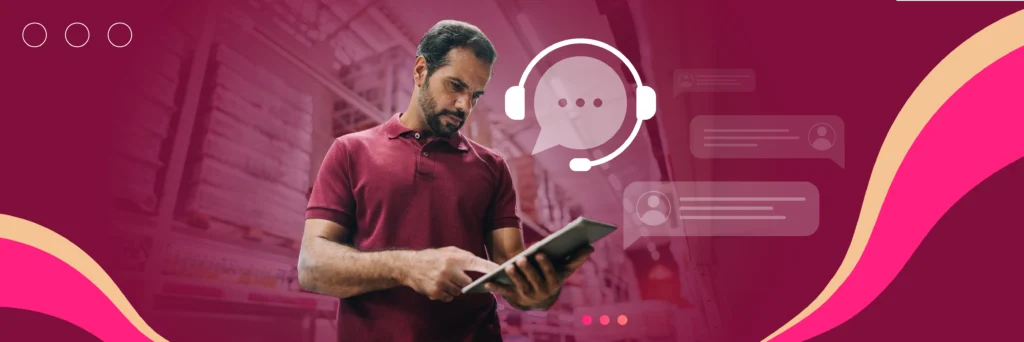
Clinton: You are an associate working on the store floor and a customer comes up and asks if you have something in inventory. You’re in the middle of stocking shelves, and now you need to help this customer. So you put this stuff down and go find a computer. And when you’re using a computer, it feels like you’re ignoring the customer while you’re trying to find inventory information as quick as possible.
What’s really exciting with Zippy having access to MCP servers now is that you just go to Zippy and say, “Zippy, I have a customer looking for this jacket in teal and a large. Do we have it in inventory?” And Zippy can not just tell you whether you have it in inventory — it can tell you, “We don’t, but the distribution center has three in stock.” And maybe it can even say, “Do you need one sent over?” To have that really immediate level of access — again, it’s like having a friend that’s plugged into everything. And then you’re able to answer the customer within seconds.
How would you describe Zipline’s broader engineering philosophy?
Clinton: The success of many other SaaS products is measured by how much time the user spends in the product. For us, we have this philosophy that the less time they spend in our product, the better. If they can find the information they need and get out in less time, that’s better for them.
So there’s a metric of success for us that’s inverted from the industry. Having a clearly defined goal like that really helps motivate everything else you do when engineering a product.
Read more about Zippy’s MCP capabilities in our Zipline expert conversation series.