
At times, it feels like HQ and frontline teams are operating in different realities.
Both are communicating. Both are trying to do the right thing. And yet in-store execution keeps breaking down.
So who is at fault?
Execution issues are usually blamed on people. After surveying hundreds of retail operations and frontline leaders, the data tells a different story: the misalignment isn’t human, it’s systemic. The structures meant to connect HQ and stores are breaking down.
Zipline’s 2026 State of Retail Communication and Execution report found that 70% of the people closest to day-to-day execution don’t have an effective way to tell HQ what’s broken.
It’s not that they’re unwilling or uncomfortable sharing. It’s the lack of a two-way communication path between HQ and the frontline that actually supports execution.
Small communication gaps create big problems
When frontline teams can’t get feedback to HQ, leaders don’t see what’s really happening in stores. And without a clear view of day-to-day challenges, HQ sets goals that are hard to achieve.
Stores end up understaffed, initiatives fall short, and fewer than half of strategic priorities get executed properly.
Across all respondents, 63% say that at least one in four store initiatives don’t land as planned, highlighting how small communication gaps can quickly turn into major problems.
Zipline surveyed 227 retail leaders across the United States and Canada, in partnership with Studio by Informa Tech Target. Download the report to discover the real business cost of misalignment.
Misalignment isn’t cultural. It’s systemic.
What we found next explains a lot. Even in 2026, a massive 81% of surveyed retail leaders still rely on email as a primary way to communicate with stores.
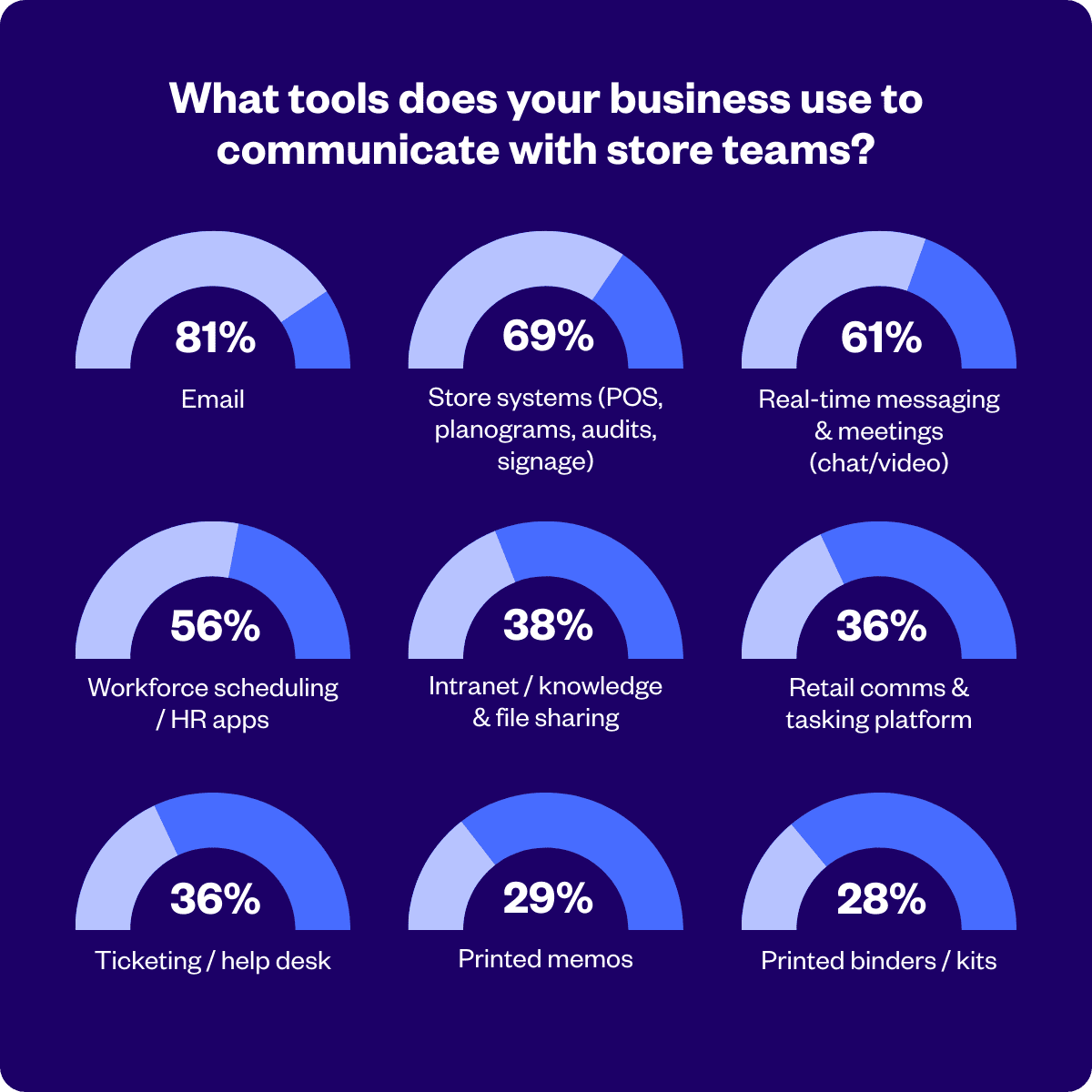
Most retailers are still running store operations on systems built for desk-based, centralized teams. Email assumes constant inbox access, linear workflows, and passive consumption of information — none of which reflect how frontline teams actually work.
Collaboration tools contribute to the gap
Here’s where it gets more interesting: believing you have a purpose-built retail communications platform and actually having frontline employees use it are two very different things.
Our new data reveals a significant adoption gap between corporate teams and frontline leaders when it comes to operational tools, one that most organizations don’t realize exists.
From HQ’s perspective, a tool is “in place,” and a box is checked. Meanwhile, however, your stores are still piecing together information from multiple sources, often falling back on the same broken channels the new tools were supposed to replace.
The tools retailers use to assign tasks, track completion, and gather feedback are often built for corporate project management, not for the unique distributed operations of retail teams. They require too many steps, too much context-switching, and too much time that frontline teams simply don’t have.
Wait — it’s 2026. Can’t AI just fix this?
There’s growing interest in using AI to improve retail execution, and AI can indeed help clarify communication, delivering resources, and surface patterns. But this technology only works when the underlying systems actually support how frontline teams operate.
If stores aren’t using your current tools because they don’t fit the workflow, adding AI capabilities won’t change that. They’ll just make broken systems faster.
HQ thinks feedback is working. Stores don’t.
Retail leaders are aligned on one thing: execution has to improve. Across both HQ and store teams, it’s seen as a top priority.
But when it comes to execution, agreement on the goal doesn’t mean alignment on the reality. The problem is that frontline teams know what’s failing but have no reliable way to say it. Feedback loops are often weak or one-way, which means the same issues repeat over and over again, and store teams are left to manage the fallout on their own.
This disconnect shows up clearly in perception. Over half of surveyed corporate leaders believe there’s a clear and effective process for raising concerns when store initiatives don’t work. Our data shows that only 30% of frontline leaders agree.
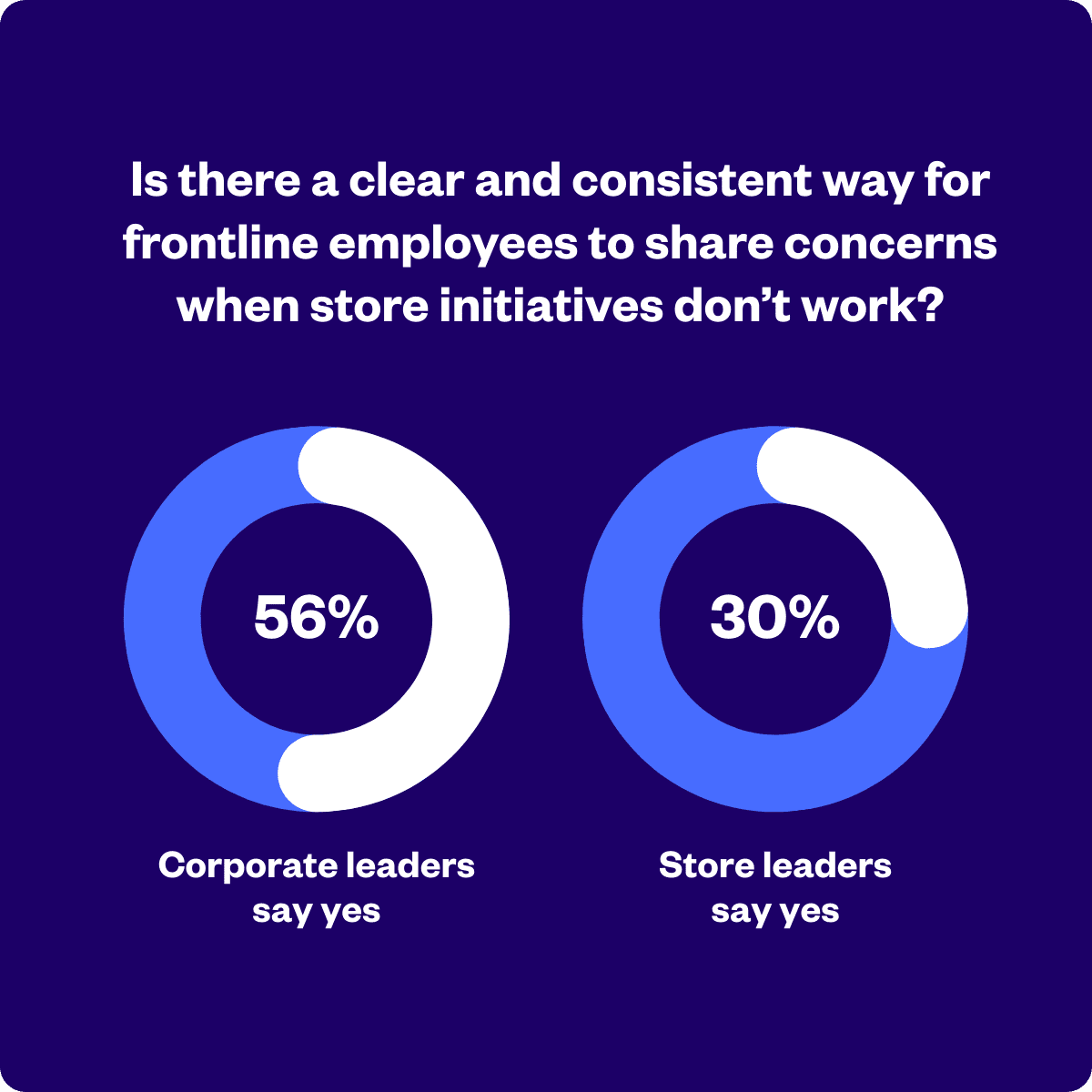
That gap leaves HQ confident the loop is closed, while the frontline knows it isn’t.
When frontline feedback doesn’t get through, morale drops and turnover rises. In an environment where staffing is already tight, that loss of people and context makes execution even harder. This, in turn, can lead to poorer customer experiences and, ultimately, lost sales.
Where does your organization land?
Even with clear priorities, small communication gaps add up quickly.
Our benchmark data shows most retailers have more misalignment than they realize. This gap leads to repeated execution failures, wasted labor hours, and turnover driven not by compensation but by the frustration of not being heard.
What feels like a series of one-off issues is usually systematic. The gap between HQ perception and frontline reality, the adoption split on tools, the stalled feedback loops — these aren’t unique problems. They’re predictable outcomes of systems that weren’t built for distributed retail operations.