
The retail market has a stubborn, expensive problem: the execution gap.
On average, only 29% of store teams execute HQ’s direction correctly and on time.
We come from retail. We’ve seen what’s really behind these numbers: stores drowning in communication but starving for clarity; HQ teams spending hours rewriting, re-explaining, and re-emailing; operational slowdowns, inconsistent customer experiences, and missed sales.
Zipline was built to close that gap. From day one, our belief has been simple: store teams want to do great work — they just need a better way to get things done.
That conviction has shaped every product decision we make: how Zipline organizes information, how it targets content to roles, how it measures execution, and most importantly, how it simplifies life for the people in stores.
AI doesn’t change our mission. It accelerates it.
Turning what the best stores know into what every store does
Great store managers know what matters most today. They spot issues early. They coach differently. They understand which tasks move the needle and which can wait. That knowledge is real, but it’s rarely written down. It lives in habits, experience, and pattern recognition.
For years, retailers have tried to scale that excellence through training, playbooks, and more communication. But you can’t clone your best leaders fast enough to fix every struggling store. The problem isn’t effort. It’s scalability.
That’s the context AI brings—not as a replacement for people, but as a way to capture, surface, and repeat the patterns that already drive great execution.
What Zipline AI means today
Today, true to our mission, Zipline AI shows up in very practical ways.
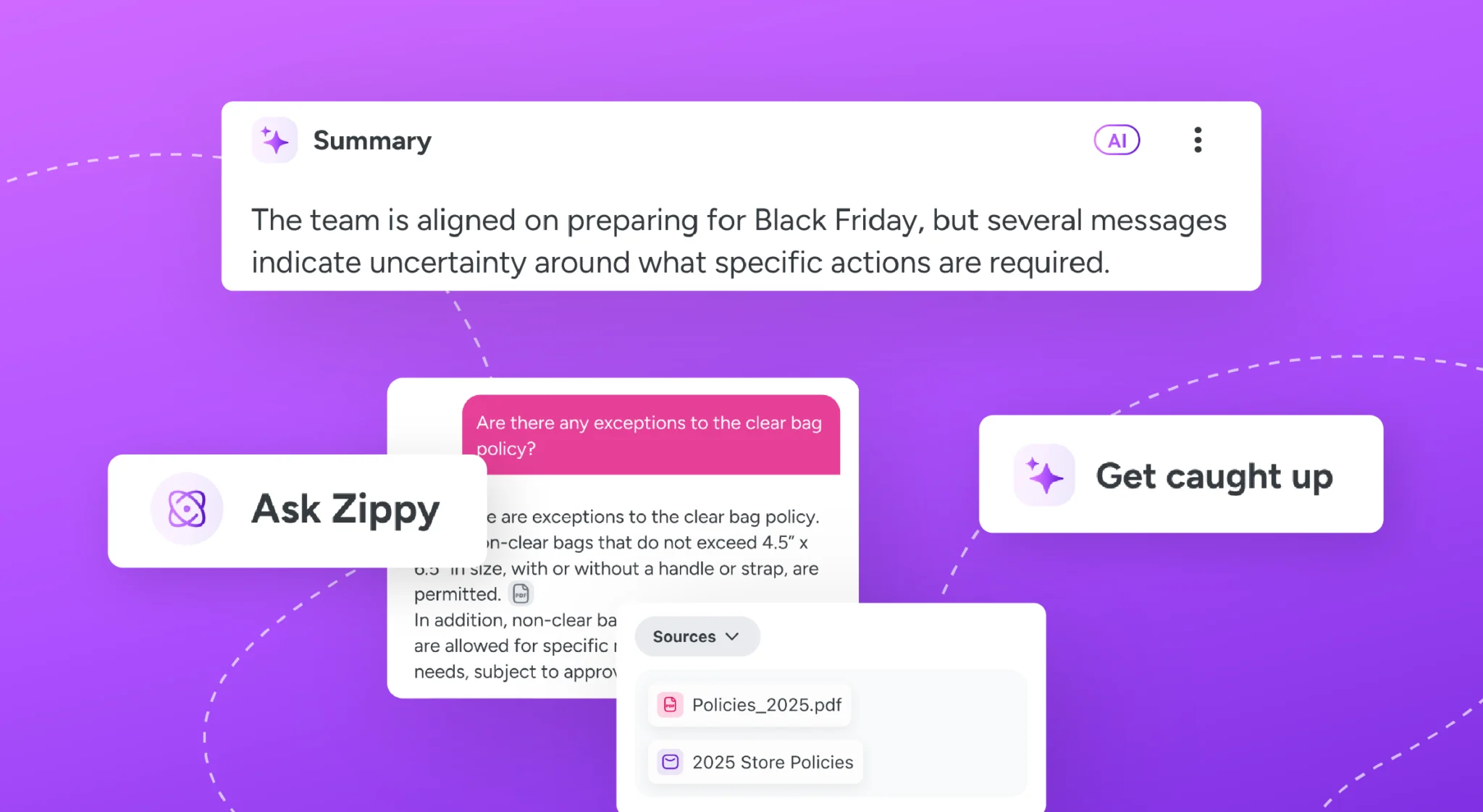
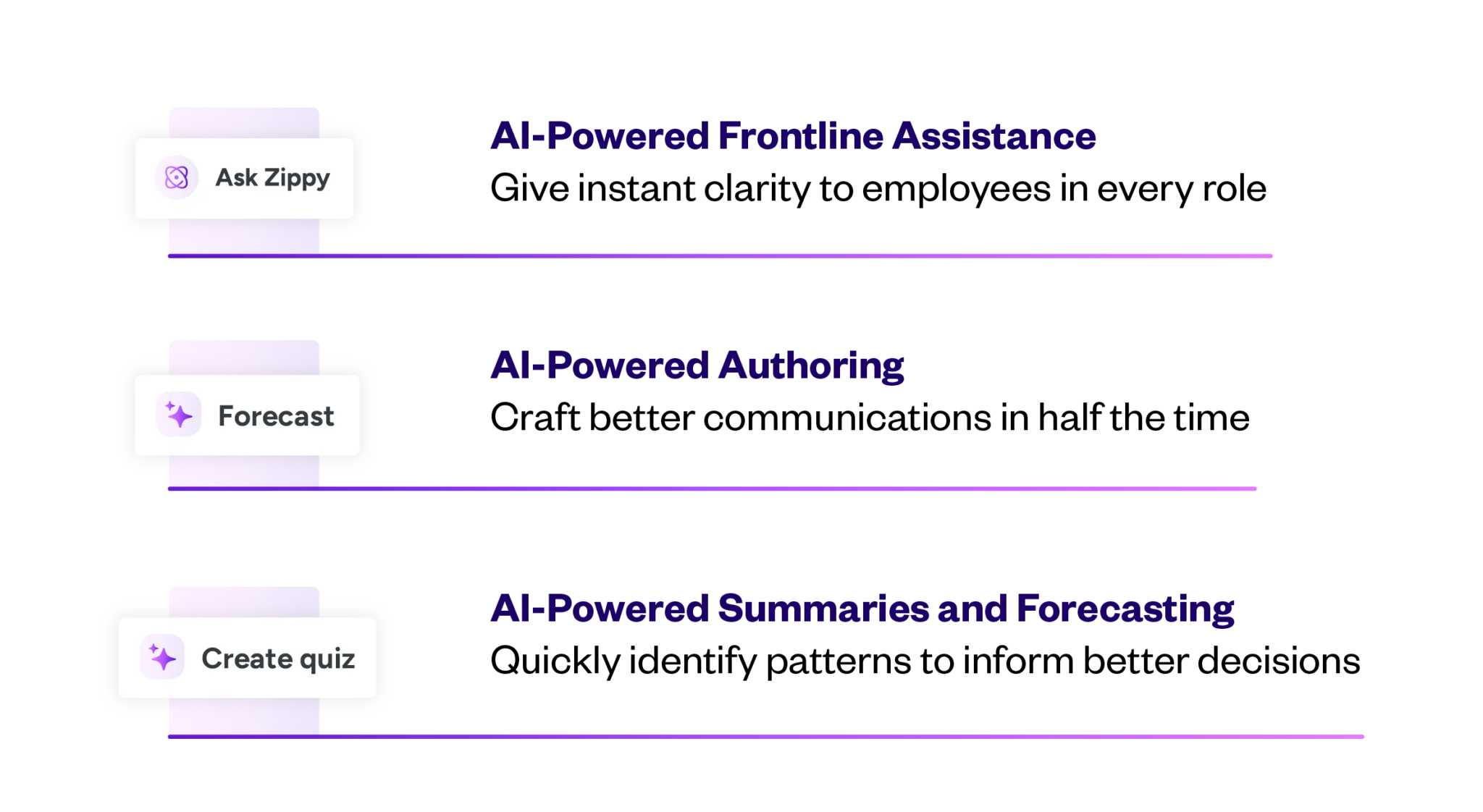
- Zippy, our AI-Powered Assistant provides instant clarity for every level of the retail hierarchy. It answers questions in the context of each user’s location and role, aggregating information and highlighting what matters most in the moment — teams spend less time decoding information and more time serving customers and supporting their staff.
- AI-Powered Authoring helps HQ teams write clearer, targeted, and more effective communications in half the time — reducing the noise that can overwhelm stores. Because messages are consistent, more digestible, and more actionable, the business sees tighter execution and faster alignment across the fleet.
- AI-Powered Summaries & Forecasting gives store and HQ teams a faster path to insight: identifying trends, spotting risks, and synthesizing feedback at scale. Whether you’re an associate catching up after three days off, or a merchant reviewing performance across a test market, AI helps you reach an outcome faster — giving you time back in the process.
These features are the result of years spent building alongside retail operators and listening closely to where work actually breaks down. Zipline AI shows up in work teams already do, solving problems they already feel, instead of introducing entirely new ways of working.
Even better? Retailers are already using these AI tools today.
They’ve already been put to the test, daily, by thousands of frontline workers across global retail brands. They’re designed to fit into the reality of a store employee’s day-to-day—not designed for slide decks, dashboards, or boardroom optics.
Where we’re headed
Our long-term goal is simple: turn what your best stores know into what every store does.
Zipline AI is becoming the intelligence engine that elevates how retail organizations operate. Working alongside real customers today, we’re already moving beyond reacting to issues after they surface and toward proactive visibility into emerging trends and performance gaps—so leaders can intervene earlier, and every store can operate at its fullest potential.
Zipline AI will support workflows end-to-end: drafting individualized content automatically, prioritizing work, routing information to the right person at the right moment, and giving every store manager clear, data-driven guidance.
It’s not about replacing human decision-making. It’s about giving teams the insight and clarity they need before they even know to ask for it.
By retail, for retail. Always.
We’ve always built Zipline in close partnership with our customers, and that doesn’t change with AI. Our models are informed by real operational workflows, real execution patterns, and real feedback from the teams using the platform every day.
That’s how we’ve always approached product development at Zipline.
AI is simply the next phase of that work.