
Corporate sends the deck. There’s a new seasonal promo rolling out — “buy-two-get-one” on summer accessories. Needs to be live by Friday. Oh, and while you’re at it, refresh the front-of-store layout to the new planogram. And make sure everyone watches the updated POS training video — it’s only twelve minutes.
The email goes out on a Tuesday. There’s also a WhatsApp ping, a follow-up in the brand portal, and maybe even a call from the regional manager.
On paper, it’s flawless.
In the store, the reality is different. By Thursday afternoon, they’re down two people. The new inventory drop arrived yesterday. Half of it’s still in the back. The POS system froze twice this morning. And somewhere in the seventeen unread emails is that planogram to be implemented tomorrow.
When the promo goes live, customers leave confused, or frustrated, or empty-handed.
From HQ, it looks done. The dashboard is green. Compliance is at 94%.
From the floor, it feels like chaos held together with duct tape and determination.
What sounds like an anecdote is a pattern backed by data. In Zipline’s recent survey of 227 retail leaders, we asked headquarters executives to rate their understanding of store operations on a scale of 1 to 10.
They gave themselves a 9.13.
We asked store leaders to rate how well HQ understands what’s actually happening on the floor.
They gave HQ a 5.67.
Same company. Different planet.
Broken execution starts with the perception gap
When store execution falls short, the post-mortem is always the same: we need clearer emails and better training.
Zipline’s findings, however, show that misalignment between stores and corporate isn’t caused by communication breakdowns — it is the communication breakdown. Every initiative that falls apart in execution can be traced back to this: the headquarters is building plans based on a version of store operations that has little to do with reality.
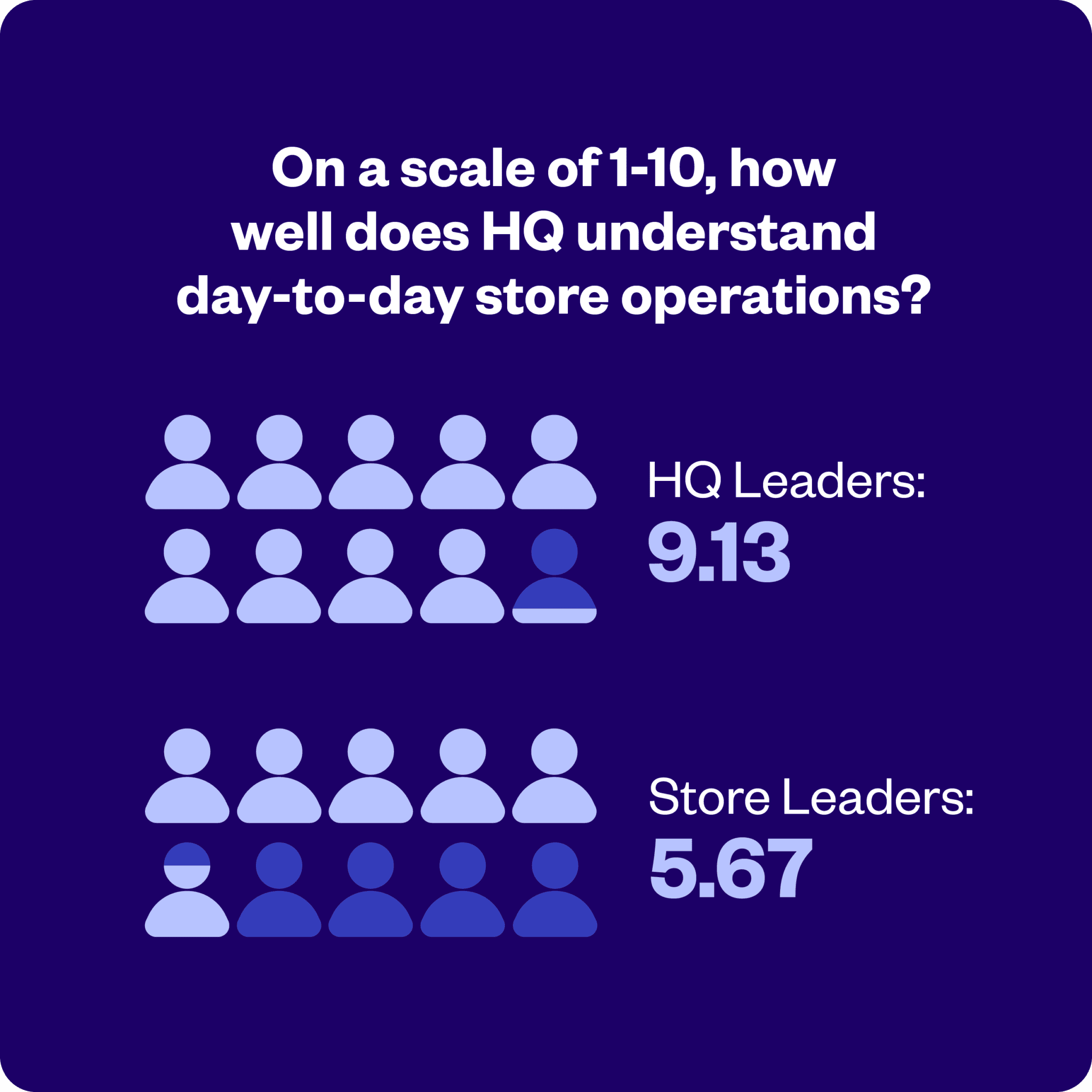
When there’s a 3.5-point gap in perceived understanding, “better communication” just means more efficiently delivering instructions that were never going to work in the first place.
Let’s dig deeper.
Why this gap exists (and why it’s so persistent)
Retail operations aren’t uniform. Ten stores in ten different locations face ten different sets of challenges. Scale that to a thousand stores, and the complexity grows exponentially.
But the problem isn’t that store-level challenges exist — it’s that people closest to execution don’t have a way to tell HQ what’s broken.
And why does it happen?
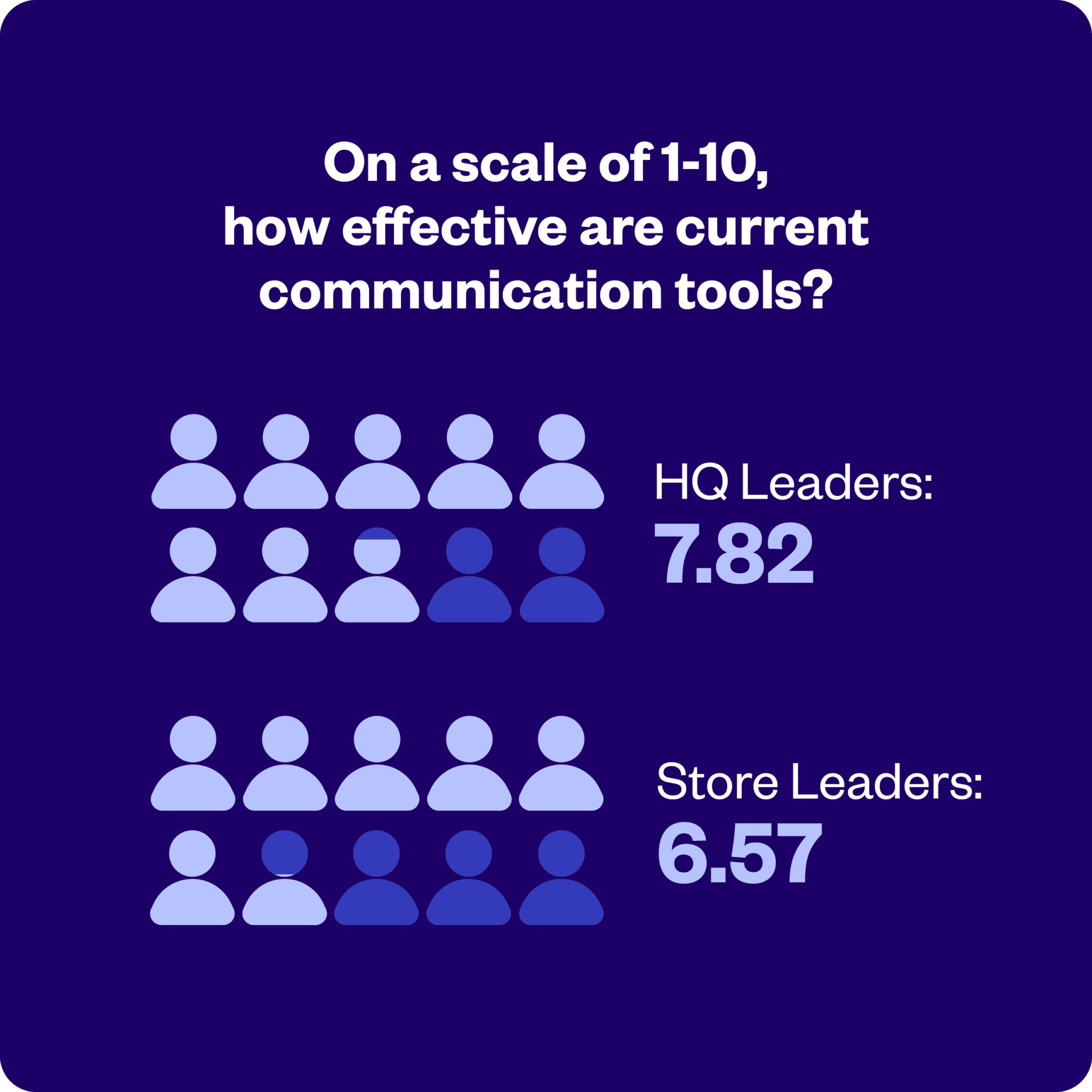
It’s because the tools they’re given make it nearly impossible. When we asked headquarters leaders to rate the effectiveness of their communication and task management tools, they gave them a 7.82 out of 10. Store leaders rated those same tools 6.57.
For most retailers, communication still lives in email and spreadsheets. These tools help to broadcast messages downward, not to surface feedback upward. Until retailers adopt systems that make feedback as easy as compliance, the perception gap will persist.
What the perception gap does to execution
Headquarters overestimates what frontline teams can realistically handle, so unrealistic tasks keep coming. They keep adding new promotions, new training modules, new compliance requirements, and new priorities.
In stores, teams do what’s only possible in this situation — they triage. They can’t execute everything, so they make judgment calls about what matters most.
The customer in front of them takes precedence over the training video. Some tasks get delayed. Some get done partially. Some get quietly ignored.
As a result, a significant majority (63%) of our survey respondents acknowledge that at least one in four initiatives don’t land.
Misaligned: The 2026 State of Retail Communication and Execution Report uncovers the biggest gaps between how HQ and stores see operations. Compare your challenges to industry benchmarks.
The downstream costs
Beyond failed promotions, the misalignment distorts where retailers invest their resources.
Training and onboarding is one example. Thirty-seven percent of store leaders cite it as a top operational challenge — they’re the ones constantly training new hires while short-staffed. Only 22% of corporate leaders see it the same way, which means over two-thirds of HQ executives won’t prioritize investing resources in these initiatives.
Next comes the turnover problem. Fifty-two percent of frontline leaders report their employees feel unnecessary stress trying to chase unrealistic priorities. That stress accelerates turnover, worsening the staffing problems that created the pressure in the first place.
And lastly, there’s a direct impact on the bottom line. Forty-three percent of surveyed retailers say missed or delayed initiatives lead to lost sales or revenue.

All of these are measurable hits to the bottom line, stemming from a gap that can be addressed at its source.
Festival Foods faced the same pattern: uneven execution, too many channels, and hours lost chasing updates.
The problem wasn’t effort. It was alignment.
When they centralized communication and made execution visible in one system built for stores, execution rates climbed to 90% within weeks.
Because HQ and stores were finally operating from the same version of reality.
Solution: Start closing the gap
The perception gap is a result of systems that were never designed to create shared understanding between headquarters and stores.
In the book Stores Don’t Suck: The 5 Principles of Amazing Retail Communication, Zipline CEO Melissa Wong identifies a pattern she saw across large retail chains: brands lacked the systems to create two-way engagement between headquarters and stores.
“Retailers aren’t providing their frontline staff with the tools they need to do their job. Store teams therefore don’t have a clear way of understanding what they need to do and why it’s so important.” — Melissa Wong, Stores Don’t Suck
Our survey data reveals the same fundamental gap. Wong argues that closing it requires an operating model built around store reality. It starts with these three practices:
Shared visibility
Store teams need context for the decisions being sent their way. Give the “why” behind each directive: why a promotion is structured a certain way, why certain products are prioritized, and why their store falls into a specific category or receives different instructions than others.
Learn how to build shared visibility into your operations.
Prioritized action
The solution to information overload is real-time, digestible communication. Instead of weekly PDF packets or seasonal binders that are outdated within days, send bite-sized, actionable updates when they’re needed.
Turn communication into infrastructure — build systems where tasks are visible and priorities are clear.
Closed feedback loop
When 70% of store leaders say they don’t have an effective way to tell HQ what’s broken, misalignment is inevitable. The visibility needs to flow in both directions.
Store teams need a reliable, frictionless way to tell headquarters what’s broken, and headquarters needs to visibly act on that input.
Build feedback into the same systems where work happens. Store teams shouldn’t have to stop what they’re doing, find the right person, compose an email, and hope it reaches someone who can act on it.
And when stores flag a problem, headquarters needs a system to acknowledge it, route it to the right people, and communicate what’s being done about it.
Frontline needs to see that their input leads somewhere, not into a void.