In every retail store in the world, one key element reigns supreme: the teams. The people in stores are the face of the brand, the stewards of the neighborhood, and the product experts customers trust.
At the National Retail Federation’s (NRF) Big Show, that reality can be easy to forget. Bright colors, bold giveaways, and flashy tech all compete for attention. Every vendor insists that they solve your problems. They claim to remove friction, increase connection, and simplify your business.
But choosing the right tech starts with a harder question: what problems are you actually solving for store teams? And does your tech empower your people, or just add one more thing they have to manage?
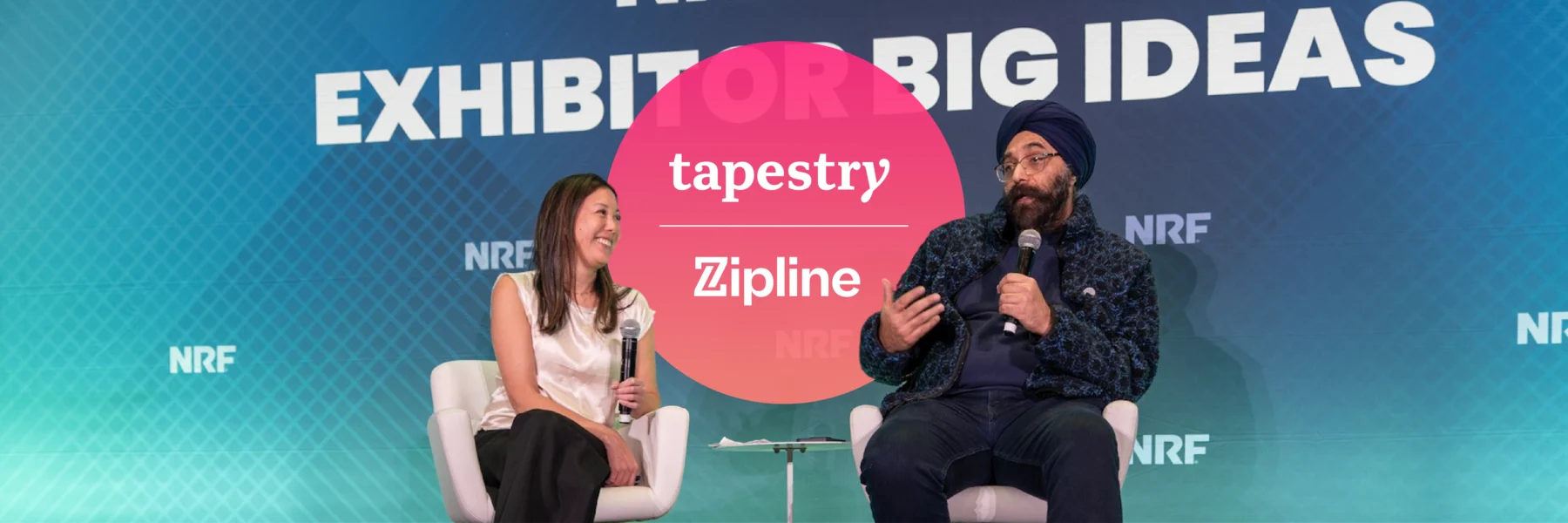
Retail is at an intriguing place. Technology in stores paired with AI is empowering store associates to be their absolute best. No two people know this better than Mandeep Bhatia, SVP of Global Digital Product & Omnichannel Innovation, Tapestry, Inc. and Melissa Wong, CEO & Co-Founder, Zipline.
I had the pleasure to sit in on their Big Ideas Session at NRF. It was insightful and made me smile. Because as a former store leader, the people on the floor were everything. For a house of brands like Tapestry (Coach and Kate Spade), innovation isn’t about replacing people. It’s about igniting them.
Igniting the Power of People
Bhatia of Tapestry was clear from the beginning of the talk: Think about how you can make associates’ lives easier. Then, “Ignite the power of the people.” For some brands, this will require a mindset shift. Shifting from viewing people as labor to seeing them as hospitality providers is a necessary shift.
A labor mindset is task-oriented. A hospitality mindset is customer-centric.
“Associates are talking to customers all the time. How do you make their lives easier? How do you remove the friction from their day-to-day—the drudgery from their day-to-day—so they can focus on building that emotional connection?”
– Mandeep Bhatia, Tapestry Inc.
Tasks overwhelm store teams. The retail store has become the catch-all for brands. They operate as a storefront, a warehouse, a product discovery zone, and a hangout. Store employees are trying to get through an ever-changing list of to-dos while also creating a fantastic experience for their customers. It’s a lot to ask. Bhatia focused on how to make it better.
His vision: a single pane of glass. For leaders like Bhatia, having a single, unified platform for stores is a non-negotiable. That’s where Zipline comes in. Critical information the stores need lives in one place. Leaders and associates stay connected, and HQ is always in the loop. Communication that used to take forever happens seamlessly in every shift.
But choosing a tech solution can feel risky. Should you build or buy? How did Bhatia decide to implement Zipline and have confidence in his decision?

Build vs. Buy
Build vs. buy is a critical question. So, Bhatia was focused on speed, scalability, and “who can help us adopt and learn?” He wasted no time. He decided to pilot Zipline right before holiday.
Many brands wouldn’t attempt anything like this. The run-up to the holidays is one of the busiest times in retail. It’s busy with customers, but the number of tasks people are juggling behind the scenes is incredible. It involves writing schedules months ahead of time, interviewing, onboarding, and merchandising like no other time of year.
To roll out a new tech solution right before holiday would make any retail exec pause, hesitate, or run. But not Bhatia. He decided to pilot Zipline in a few stores. The results were positive. The stores loved it. When store teams love something new during the busiest time of year, you know you’ve won.
And the pilot delivered more than a unified platform: it introduced Zippy.
Zippy – The Ultimate AI Store Assistant
Zippy is Zipline’s AI assistant, always available to help associates find answers and move faster.
For Gen Z, AI is a natural part of the work. In fact, a 2025 survey revealed that eight in ten Gen Z employees already use AI like ChatGPT or Claude at work, so using an assistant named Zippy feels intuitive, not disruptive. When tech feels familiar, adoption isn’t a hurdle.
That familiarity shapes how Zippy works. Zipline equipped Zippy with role-based intelligence. So, it answers questions based on specific roles in the store (manager vs. associate). When a manager logs in, it can answer specific questions for them. Associates don’t need the same set of information, so it has tailored information for their questions.
This always-available, intelligent tech lets store associates move quickly. They go from searching to acting faster than ever before.
“Our goal with Zippy is to really enable every store manager or every store employee to really be the best store employee.”
– Melissa Wong, Zipline
Is AI Making Us More Human?
I’ve been hearing this sentiment a lot lately. AI will make us more human. I understand why. AI is eliminating a lot of time wasting and connecting us faster than we could before.
Zipline uses AI like Zippy to get employees accurate information fast.
The financial dashboard gives associates real-time visibility into the business and builds ownership. High-level leaders in the field and partners at HQ make quick videos and send them directly to stores, improving communication flow and fostering team building.
During the panel, Melissa Wong noted, “AI can enable people to do their best.” That’s exactly what Zippy is doing. Removing all that time spent searching is making a major roadblock disappear. AI handles the mundane so humans can focus on hospitality.
Humans Are the Heart
Tapestry chose a partner who focuses on adoption and learning, not just features. They want their teams to express themselves. They understand that the associates are the heart of the business.
When store leaders are no longer stuck in the back office reading emails, they get time back and flexibility to lead from the floor. They can be anywhere and still have the tools they need to do their job. That’s huge.
Both Bhatia and Wong lead large companies. While one is a traditional retailer and the other is in tech, their visions align. People are at the heart of every decision. The tech that connects us can even make us more human.
We’ll leave the bright, flashy tech to someone else. Over here, humans are the heart.
About Kit Campoy
Kit Campoy is a retail expert and author of the book, The Retail Leader’s Field Guide. She spent 46,000 hours in stores leading teams. Today, she trains frontline teams and writes for world-class SaaS retail tech brands.