
Why do retail initiatives fail? According to Zipline’s 2026 State of Retail Communication and Execution report, the root cause is a lack of communication infrastructure.
It’s an easy conclusion to miss, because staffing feels like the most obvious answer. Even Target Corporation thinks it is: the retailer recently cut roughly 500 corporate roles to reinvest directly in store staff.
Our own report, Misaligned: The 2026 State of Retail Communication and Execution—a study of 227 retail leaders across the US and Canada—seems to back that belief: 45% of HQ leaders and 57% of store leaders cite insufficient staffing as a key reason retail initiatives fail.
But dig deeper into the findings, and you’ll see staffing is a symptom, not the disease. Our new data has uncovered the root causes behind your failed retail initiatives.
Issues that no hiring budget can fix
Picture a three-person team on a regular Friday evening when a promotion goes live. One person is on register, one is managing the floor, and one is in the back. Of course, they don’t have the bandwidth to successfully implement the new promotion. Court adjourned.
But wait—then how did Festival Foods achieve a 90% execution rate without increasing headcount? They did it by fixing what was breaking before work ever reached the store floor: how tasks were communicated, prioritized, and tracked.
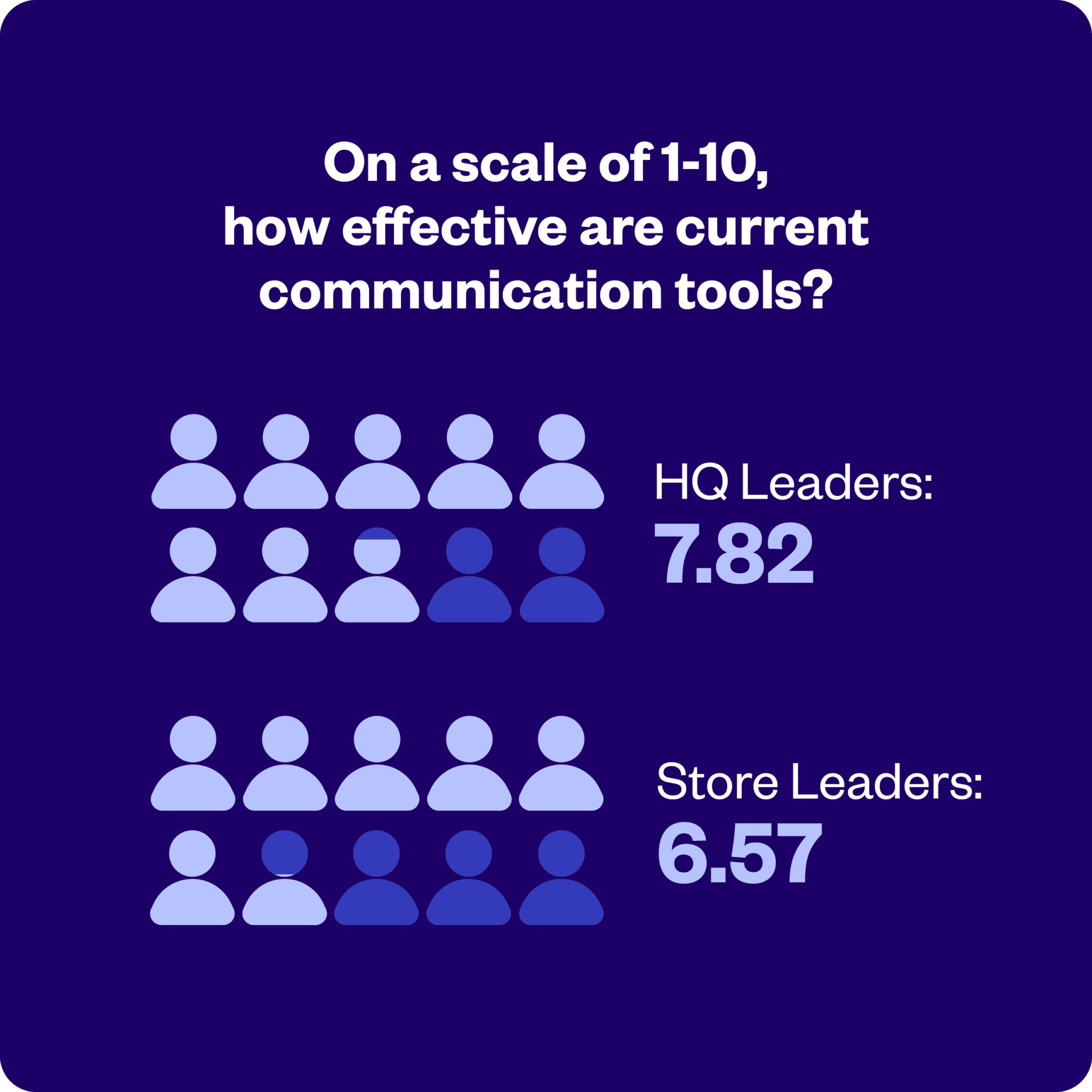
Most retailers think they’ve already done that. Nearly every company has some form of messaging platform in place to communicate with store staff and assign tasks. As per our report, HQ leaders rated the effectiveness of their communication and task management tools at 7.82 out of 10, which isn’t bad at all.
However, store leaders rated the same tools 6.57 out of 10.
That gap—more than a full point—is where initiatives go to die. Hiring a fourth person for that Friday shift wouldn’t help if the assignment had never landed in the first place.
The three drivers of poor retail execution
Behind every failed initiative is a cluster of operational pressures that don’t show up on a performance dashboard, but they undermine execution every day.
A third of survey respondents cited too many competing priorities at the store level. Nearly as many pointed to insufficient time to complete tasks, misalignment between HQ expectations and store realities, and inadequate training or guidance—each landing between 30% and 32%.
Read those in order, and you can spot a pattern. Guidance is thin, so teams don’t know how to execute. Expectations don’t match reality, so teams can’t meet them. Too much lands at once, so teams have to choose. By the time a store manager is staring at an understaffed Friday shift, they’re already dealing with the accumulated weight of decisions made further up the chain.
Staffing is what breaks first, but it breaks because the foundation was already cracked. It’s the most cited problem because it’s the most visible. But it’s not where the problem begins.
Download Zipline’s 2026 State of Retail Communication and Execution report to see what’s behind your failed retail initiatives.
Alignment is the prerequisite
The problem begins with a gap in shared reality. One that drives conflicting priorities, mismatched expectations, and inadequate training. In its turn, this misalignment starts with how communication reaches the frontline.
Most retail communication isn’t built for store teams. Associates can’t monitor email throughout a shift. Planograms buried in thread after thread aren’t findable when they’re needed. On the other side, HQ sees the checkmarks and assumes alignment.
Neither side is wrong about what they’re experiencing. HQ is working with the information they have. Store teams are doing the same. But without a shared system that closes the loop, both sides remain misaligned—each solving for their half of the problem while the other half stays broken.
The good news is, it’s solvable, and you don’t need the organizational overhaul. You need the right information reaching the right people at the right time, with clear ownership and a way to verify it happened.
It sounds simple.But in practice, it requires turning communication into infrastructure.
Fix the system, not the headcount
Closing the execution gap comes down to three things (none of which is hiring extra staff):
1. A system that creates a shared reality.
On paper, retailers have this covered. Over a third of organizations already have a purpose-built retail communications and task-tracking platform in place.
But having a system and using it are two different things.
Nearly half of HQ leaders use it, while less than a quarter of store leaders do. A platform that only half the organization is on is just another tool HQ uses to send messages that don’t land.
Systems like Zipline are designed specifically to fix this problem — accessible on the sales floor between customers, not just at a desk. It’s one platform that serves as a single source of truth for everyone, instead of the email chains that 81% of retail leaders still rely on.
2. Communication that matches its purpose.
A single platform doesn’t automatically solve the problem. If you move all your communication into one system, you’re just trading scattered inboxes for a single, overwhelming one.
The right message has to reach the right person at the right time, and be accessible at the moment it’s needed.
Using Zipline, employees see a targeted, prioritized view of what the day requires. Tasks are located in tasks. Reference materials are searchable on the floor. Company updates don’t compete for attention with time-sensitive directives.

3. Measurable execution.
Measurement has to run in both directions. HQ needs to see what’s being completed, where, and to what standard. Store teams need a way to flag when something isn’t working, which, based on our findings, 70% of frontline leaders fail to do with current systems.
Retail operations platforms like Zipline close this loop. Task completion rates, photo confirmations, and store health scores give HQ a real picture of execution across every location and region in real time. In turn, store teams can surface issues, share rollout reactions, and flag what isn’t working—right from the floor.
When communication is clear and coordination works, something else happens too: the job gets less frustrating. Teams aren’t chasing instructions or guessing at priorities. Leaders aren’t firefighting. And when the daily experience of working in a store improves, people stay longer—which takes pressure off the staffing challenges that feel so urgent in the first place.