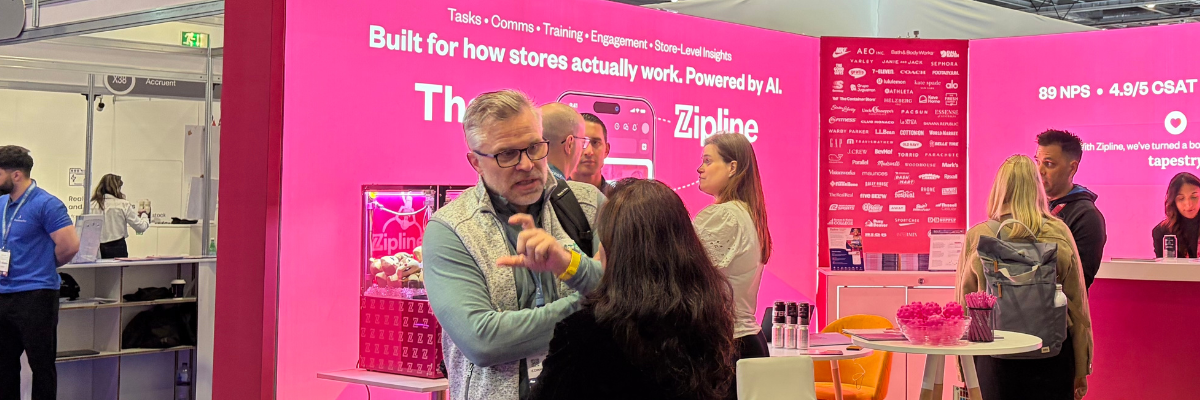
The Retail Technology Show returned to London’s ExCeL in April 2026, bringing together leading retailers, operators, and technology providers across two days of sessions, panels, and floor demos.
RTS 2026 had no shortage of excitement with AI announcements, cybersecurity war stories, and self-checkout innovations. But one thread ran through nearly every conversation: physical retail isn’t in decline, it’s in reconstruction.
It’s being rebuilt around the people on the floor, the processes behind them, and a sense of what a physical store is actually for. If RTS 2026 made one thing clear, it’s that the store is the most powerful personalization tool retailers own today.
Rediscovering the shop floor
For a long time, retail bet heavily on digital experiences. That meant, better algorithms, smarter retargeting, and frictionless checkout. Now, with digital channels becoming noisier and excessively harder to cut through, the store is getting a second look — and a different brief.
Axel Arigato, a premium apparel brand, started online, built an audience online, and then made a deliberate choice to open physical stores.
At RTS 2026, Mitchell Vergeer, its Head of Retail, emphasized that the question was never how to replicate what the website already does well, but how the store could do something the digital experience simply couldn’t.
That means ensuring that a store is a place worth making the trip for, not just where you go to return a product you ordered online.
Anthony Hanson, Group CEO of Holland & Barret, shared how they reorganized stores around customer needs rather than product categories and introduced wellness studios, diagnostics, and personalized consultations at physical locations. They’re among the first traditional retailers shifting to something closer to a service provider, but definitely not the last.
What customers want from physical retail
“Good service is expected now. Something that five years ago would have been seen as exceptional is expected now. So you’ve got to do more than that.” Claudia Nappo, COO at LK Bennett, perfectly summarized the mood across the industry.
If the baseline has moved, the question becomes: what does “more than that” actually look like on the floor?
Customers walking into a store in 2026 aren’t impressed by a warm greeting and product knowledge — it’s not even the quality of a product. They can get it anywhere they want.
Harrods has been solving this longer than most. Fifteen million visitors a year, ranging from occasional tourists to fourth-generation clients and over twenty royal families. Mark Blundell, Chief Retail Officer, explained that the expectations for personalization for their highest-value clients are really high: “they expect us to know where they like to go on holidays, which restaurants they like to eat in, how many children they have, when their children’s birthdays are.”
Not every retailer is operating at that level — but it sets the direction. The customer expectation, scaled down or up, is the same: to feel known.
The experience starts on the inside
Most retailers at RTS — Footasylum, LK Bennett, Axel Arigato among them — have landed on the same conclusion: customer experience is an output of employee experience.
It all starts with hiring. Both Footasylum and Axel Arigato have moved away from traditional recruitment toward finding people with genuine curiosity and the instinct to build a real connection before reaching for a sale. Product knowledge can be taught. Warmth can’t.
Beyond that, your brand identity shows up in places most retailers don’t think to look, such as the return process. Claudia Nappo of LK Bennett has warned the audience: tie returns to employee commission, and no amount of training will produce a warm welcome when a customer walks back in with an item to return.
“Good service is expected now. Something that five years ago would have been seen as exceptional is expected now.”
– Claudia Nappo, COO at LK Bennett
The answer is never “more tech”
When something isn’t working, it’s only natural to look for a tool that fixes it. Customer experience feeling flat? Add a loyalty app. Store execution inconsistent? Roll out a new platform.
At RTS 2026, we saw a trend toward a more disciplined way of thinking about tech adoption.
Retailers have successfully moved from asking “What’s the most innovative tool available?” to “Does this make our people more effective?”
There’s a growing realization that every tool added is another thing a frontline worker has to manage. Retailers want less technology to juggle, less time away from the customer, and more room for the conversations on the floor.
AI belongs behind the counter
If the answer isn’t more tech that members of staff have to manage, where does technology earn its place?
At the show, AI emerged as the clearest candidate.
Footasylum has shared how Zippy — Zipline’s conversational AI assistant — gives frontline staff instant answers from their device, without leaving the shop floor or the customer. We covered the full story in our RTS session recap with Shannon Osman, Retail Director at Footasylum.

Iain Robertson of Fortnum & Mason described using AI agents to give store staff instant access to knowledge across 20,000 SKUs — so someone on the third floor can answer a question about the food hall without leaving the customer.
That’s where AI earns its place in physical retail: empowering the person in front of the customer to be more effective, without getting between them.