
When you’re operating stores in a third-party labor environment, and your day-to-day reality includes both your own internal stakeholders and a major client, communication can get complicated fast.
That’s the reality for Mosaic, a company that partners with major brands to bring retail experiences to life. In addition to experiential marketing and assisted selling programs, Mosaic operates Google’s nine U.S. retail stores, embedding highly trained teams directly into Google’s physical retail footprint.
That structure means communication doesn’t flow from a single source. It comes from Mosaic. It comes from Google. And it all lands on store teams who still need to execute flawlessly.
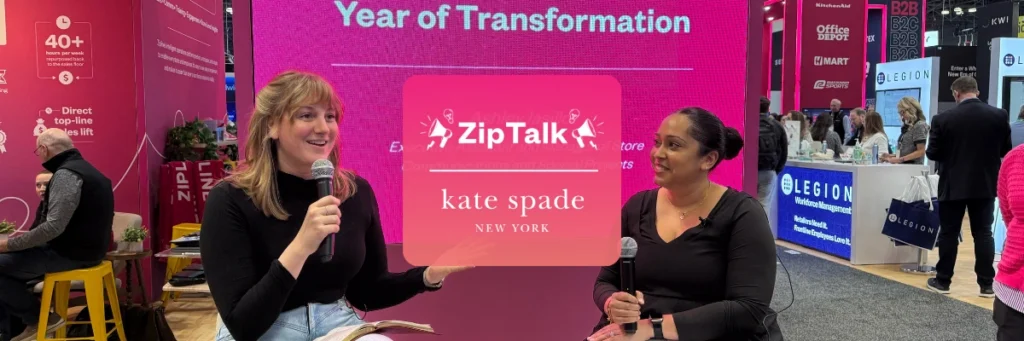
During their ZipTalk at NRF, Sara Cavolo, Senior Director at Mosaic, and Kevin Moeti, Senior Account Manager at Mosaic, described what it felt like on the ground: “We’re overwhelmed. We don’t know what to prioritize. We have way too many communications coming from left, right, everywhere.”
A year ago at NRF, Mosaic came to the Zipline booth with a simple message: “We need help.”
Ninety days into rollout, they’re now seeing what happens when you replace scattered communication with one centralized system—and when you launch with intent from day one.

The Challenge: Too Many Messages, and Zero Line of Sight
Before Zipline, Mosaic’s issue wasn’t that they weren’t communicating. It was that communication was coming from too many places, in too many formats, with no way to confirm what was landing.
“There’s Mosaic, and there’s Google,” says Sara. “There’s a lot coming from both entities.”
The downstream impact hit store teams hardest. Information came through email, chat, and whatever else was easiest in the moment. But once something went out, Mosaic couldn’t see what happened next.
“We had no line of sight,” Sara said. “We had no idea if it was actually being read or if the task was being executed. We had zero line of sight.”
And the only way to find out was the same way every overstretched HQ team tries to solve the problem: follow up, dig through threads, and hope someone responds.


The Approach: A Phased (And Deliberate) Rollout
What’s interesting about Mosaic’s story is that they didn’t treat Zipline like a quick tech install. They treated it like an operating shift, something that needed structure, governance, and buy-in.
Kevin described their implementation as a “winding road map,” adding, “it hasn’t been a seamless straight line,” especially because “when you start on a journey like this, there’s so much information. You’re overwhelmed.”
Instead of trying to do everything at once, they moved through four phases: foundation, strategy, execution, and readiness, with a clear goal… build trust early, then scale.
A big part of their foundation work was learning from the Zipline customer community and aligning cross-functional partners internally (HR, ops, IT) to make the rollout stick. Kevin’s advice for anyone starting out is straightforward: “Get early alignment and buy-in from your cross-functional partners internally, externally, everywhere.”
Because when you’re rolling out a new system, alignment isn’t just a nice-to-have; it’s the difference between progress and endless friction.

The Strategy: Governance, Process, and Pacing the Message Inflow
From there, Mosaic got serious about governance. Who publishes? Who approves? When does content go out? They built detailed SOPs so communication wouldn’t revert to chaos the moment things got busy.
They also created an intake calendar to track what was coming into comms—not just what they were pushing out. And once they had that data, they got a clearer picture of what store teams had been living with all along.
“Zipline really confirmed what we thought was true,” says Kevin. “We knew that we were overwhelming our teams already, but we really had no way of measuring it.”
This is one of those underrated “wins” that doesn’t show up in a feature list: visibility changes behavior. When you can finally see volume and velocity, you can start making smarter calls about pacing.
The Execution: Start Fresh, Build Buy-In, Launch With the Essentials
When it came time to build what would actually live in Zipline, Mosaic focused first on evergreen content and treated freshness as a prerequisite, not a bonus.
“We learned very early on that if teams feel like something is not current or something is not maintained, they lose trust in the platform,” Kevin said.
Then they did something simple that made the launch feel less corporate and more owned: they got the team involved in naming their Zipline instance. The winning name was Dino Den, a play on the Chrome Dino.
For go-live, Mosaic launched with a phased rollout. “Only messages, field publishing, resource library, and tasks were our first modules to go,” said Kevin. The goal was clear: get the basics right, then expand.

Ninety Days Later: “From Chaos to Some Clarity”
The early wins were immediate, especially in terms of noise.
Kevin described the old reality: two email addresses, constant forwarding, and digging for old threads. “Now everything just lives in one tool.”
And once messaging was centralized, the biggest shift was visibility.
Instead of sending information into the void, Mosaic could finally see what was being read and what needed follow-up. Kevin called out “real-time feedback,” explaining that “readership is one of the insights that you can have within the tool.”
Most importantly, Mosaic is now learning how to manage pace in a measurable way, including a predictable cadence. “Every Tuesday and Thursday, a bundle will come out,” Sara said. “Is that the right cadence? We don’t know yet. We’re still analyzing that.” But it’s a starting point, and crucially, it’s visible.
And for Sara, one feature stands out as a culture-shifter: Daily Message.
“My favorite part of the tool is the daily message,” Sara says. “It provides transparency no matter what your role is.” Store-wide KPIs and updates aren’t just for managers anymore.
“Anybody who walks in that store every day knows where they stand and they’re part of the journey.” – Sara Cavolo, Senior Director at Mosaic
The Bigger Payoff: Trust and Execution in a Client Environment
Mosaic’s rollout isn’t happening in a vacuum. They’re embedded with Google, and in that kind of partnership, execution and visibility aren’t internal concerns. They’re part of the client relationship.
Sara framed it clearly: “Because we’re in this client relationship with Google, they need to have trust in us to execute.” With reporting and visibility, Mosaic can now see where teams are “at all times,” and that transparency helps reinforce confidence that directives will be executed consistently.

What Mosaic Would Tell Anyone Starting Out
Ninety (impressive) days in, Mosaic has covered a lot of ground, and this is just the beginning.
Kevin summed up what they’d tell any team feeling overwhelmed at the starting line: get your people aligned early, keep content fresh, and stay willing to adjust as you learn. “Get early alignment and buy-in from your cross-functional partners internally, externally, everywhere,” he said. From there, the discipline is ongoing: “Audit and maintain your content regularly.”
And maybe the most useful reminder for any rollout in retail: you don’t have to get the cadence perfect on day one, you just have to be willing to respond to what the field is telling you. “Don’t be afraid to pivot based on feedback, based on what you’re learning in the moment,” Kevin shared.
After ninety days, Mosaic’s story is less about launching a tool and more about building momentum. It’s about taking a communication environment that felt like “drinking out of a fire hose” and replacing it with more structure, more visibility, and a clearer path to execution.
And they’re just getting started.
👇 Watch Mosaic’s full ZipTalk from NRF:

Mosaic’s first 90 days prove a simple point: when communication is centralized, execution gets easier—for everyone.
Want to see what that could look like in your stores? Request a demo.