
The retailers setting the standard for store execution right now share a few things in common — and a few of them made it plain on stage at Shoptalk this spring. Legendary brands including Lululemon, LEGO, and Arc’teryx have track records turning HQ strategy into memorable brand experiences for their customers across markets and locations.
With each brand pointing toward different entry points for better store execution, it’s clearer than ever that brands aren’t reaching for the same strategies across the board. Instead, they’re building community, signalling authenticity, and learning their customers inside and out — from digital to in-store.
If you build community, they will come
Store strategy begins long before a brand opens its doors in a new location. Lululemon has seen this across markets and they believe in the strategy so much that they now have a reliable playbook for it.
“Before we even open a new market, the first roles that we actually appoint go into the market before the store even exists. And those are the community leads and our strategic sales partners. explained Sarah Clark, EMEA SVP at Lululemon. “And their job is to go in and make local connections over the months with gyms, studios, with local ambassadors.”
Clark credits a community-centric strategy with Lululemon’s Regent’s Street location achieving over 50% local customers despite being in one of Europe’s busiest and well-known shopping districts. Lululemon’s emphasis on community engagement has meant they’ve met 55,000 people in 12 months at community events in EMEA alone.
In-person community efforts can go a long way, with 89% of businesses in one survey reporting that collaborating with other businesses in the community translated to increased sales.
This kind of coordination can be difficult to cascade down from HQ to teams on the ground. This is when retail operations platforms like Zipline come in to help brands set out priorities and hold teams accountable before, during, and after launch.
By prioritizing community-building and collaboration, brands like Lululemon aren’t just saying “we want to sell to you.” They’re building partnerships that increase local visibility and create excitement that leads to sales.

But these businesses aren’t just heading out into the community, they’re also taking a look inward, at their brand DNA, to better serve customers.
Know your customers by knowing your brand
In a discussion on macro forces shaping European retail, Ira Kalish, Global Chief and US Economist at Deloitte and Ted Utoft of IPSOS admitted that consumer behavior is getting harder to predict. That’s because of factors like economic uncertainty, looming shortages, and falling consumer confidence.
While many brands are looking for ways to chase profitable trends and better translate HQ strategy in order to overcome this uncertainty, brands like Arc’teryx are re-learning themselves to make more customer-aligned decisions.
Despite having celebrity fans, Arc’teryx says that instead of chasing trends to make sales, they’re focused on their legacy and brand authenticity. Along the way, that meant making tough choices about where the brand was headed.
When Arc’teryx switched from majority wholesale to D2C, they knew they were going to have to make serious changes to the business. “A large part of our wholesale accounts weren’t going to fit. And so in 2021 and 2022, we exited about 40% of our wholesale accounts. That created space for us to introduce an exciting new retail expression that created the brand that we wanted to build,” explained CEO, Stuart Haselden.
Figuring out their brand’s best self, also involved killing a sub-brand and getting focused so they could put their energy elsewhere. Stuart explained that upon reflection, 24, their sub-brand expansion, started seeming like the wrong path. “To move into a space where we had little competitive advantage or authority didn’t seem like the right path. So we actually killed the 24 project [and] doubled down on performance.”

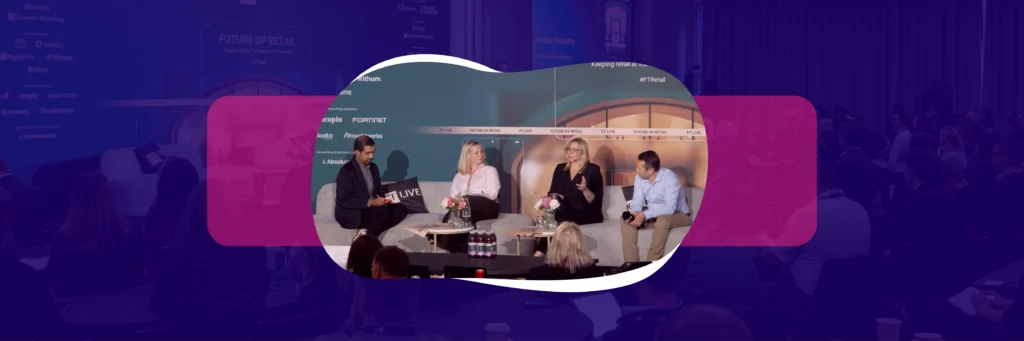
Image source Shoptalk YouTube
It’s common for growing brands to be pulled in new directions or hold on to channels, products, and partnerships that helped them scale. But Stuart says having a clear vision is what empowers them to now say no to opportunities that aren’t a fit, which leads to better customer experiences across the board.
A continuous loop from digital to store
Digital and in-store aren’t competing channels: they’re a feedback loop. The best brands are using one to predict and personalize the other in order to create seamless and delightful shopping experiences no matter the venue.
In their panel discussion “More Than a Store: Bringing the Brand to Life” Dimas Gimeno (WOW Concept), Sarah Clark (Lululemon), and Shweta Munshi (LEGO) agreed that retail powered by digital was much stronger than retail or digital on their own. Think of it as a better orchestration layer between digital, CRM, earned media, and corporate communications as well as the physical store.
The panel acknowledged a ceiling that can exist with digital-native retail and said physical retail can be cost–efficient when digital brands hit that growth ceiling. It can also be how brands create unique moments for customers.
The retailers at Shoptalk highlight the power of in-store media. They say in-store media can also persuade in a way that makes physical experiences essential to customer influence. 75% of product decisions are made in store and retailers are paying more attention than ever to in-store dwell time, audience relevance, and the complete customer journey.
It’s not just the digital promotions pushing in-store offers, it’s the store experience when they get there — from merchandising and operations, to in-store media, and unique brand moments that can’t exist anywhere online.
Planning in-store experiences can often be tricky without clarity on responsibilities and offerings. Zipline helped Kave Home become more aligned during their global expansion so they could be more focused on the floor, rather than being distracted by complex operational nuances.
Community, authenticity, and personality for better store execution
The thread running through Lululemon’s community playbook, Arc’teryx’s brand clarity, and LEGO’s digital-to-physical loop isn’t a single strategy: it’s operational discipline. Their representatives at Shoptalk all showed that big ideas don’t become great store experiences without the infrastructure to carry them from HQ to the floor at scale.
It’s a lesson that Zipline customers understand well. Footasylum, for example, knew exactly how much being digitally fluent uplevels brand loyalty and reach, which is why they chose Zipline to help them deliver on that same brand promise across their 66 UK locations.