For Zipline’s lead data scientist, Nerea Ruiz de Gauna de Santiago, helping retailers understand useful signals amid a mountain of data is all in a day’s work.
For the past two years, she’s helped Zipline’s customers understand how day-to-day behaviors impact store success. Now, Zipline has launched ZipCoach, a product innovation that empowers retailers to go deeper and get clearer about what actually improves store performance and what they should do next that allows them to improve store performance.
We sat down with Nerea to learn more about her work and how ZipCoach helps brands uncover critical insights and guides them on actions to take that drive revenue and performance.
This interview has been edited for clarity and brevity.
Hey Nerea! Thanks for talking with us today. Could you tell us a little about yourself and what you do here at Zipline?
Nerea: Sure. Hello, I’m Nerea. I’m a lead data scientist here at Zipline, and I’ve been here for about two years. Basically, we use the data sets we have to uncover patterns and generate intelligence that can help not only frontline employees in their day-to-day, but retail operations in general. A big part of what I do is work directly with customers. We sit down with them and figure out what their pain points are, what their opportunities are, and how we can help in their day-to-day work.
I’d love to know more about how you work with customers to understand how their teams’ day-to-day behaviors affect store performance. Is there anything in your work at Zipline that’s changed how you think about the connection between specific behaviors and sales performance?
Nerea: Sure. There are a few things that have shifted for me. The first is how much of the performance difference sits in the day-to-day. We all know big strategic initiatives matter, and there’s a huge amount of emphasis and effort put into them, rightly so. But when you actually look at why one store is outperforming another, a lot of it comes down to the small things: what the team does every day, how quickly they pick up a communication, whether tasks get done on time, who’s working together, the routines they keep. And that’s great, because those things are completely controllable. A leader can actually do something about them.
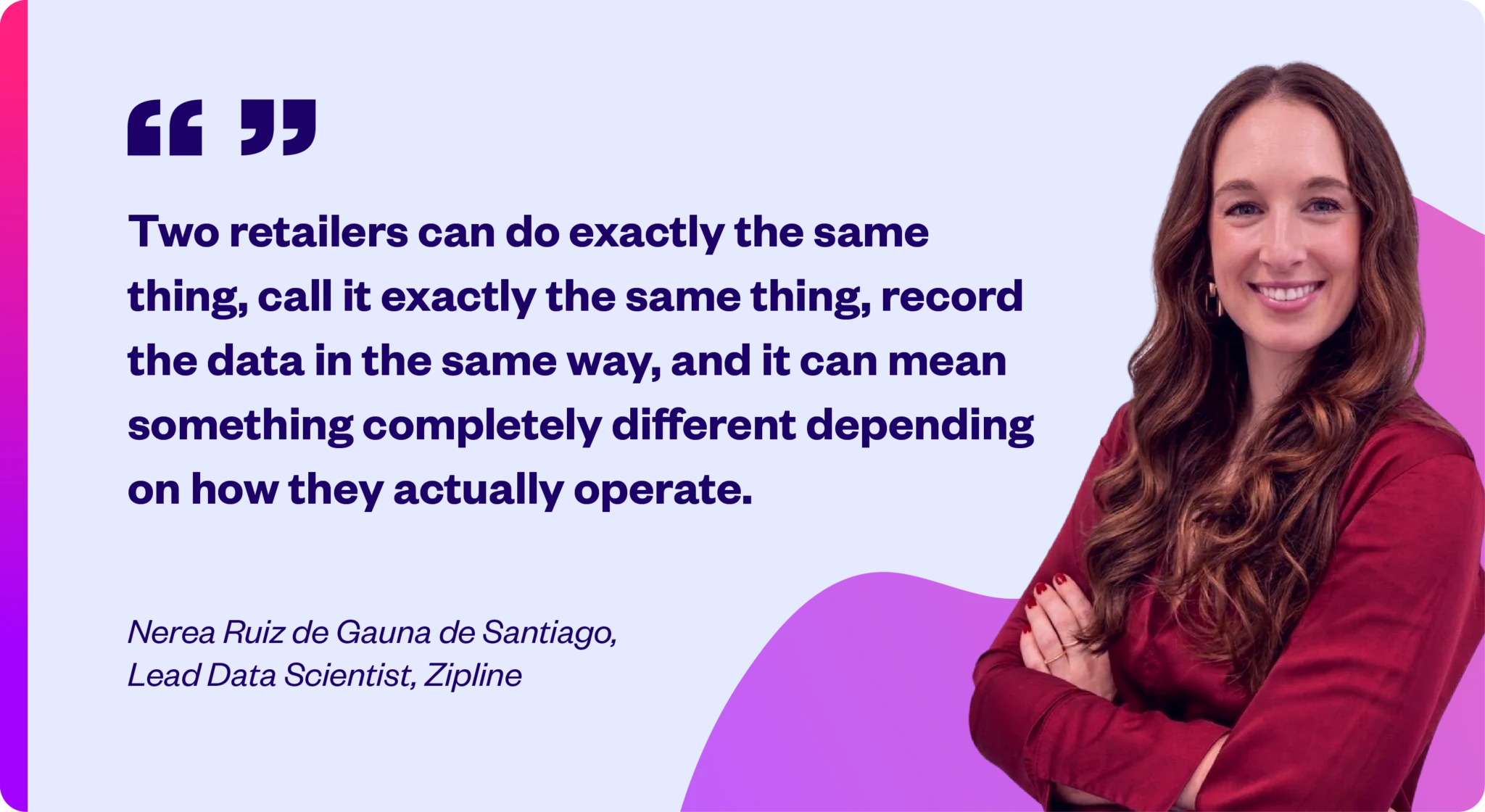
The second is how much you have to tailor to each brand. There are so many nuances. Two retailers can do exactly the same thing, call it exactly the same thing, record the data in the same way, and it can mean something completely different depending on how they actually operate. So you can’t take the data at face value. That’s really where the beauty is: the combination of understanding the data itself, the things that generalize across retailers, and what’s very individual to each of them.
The third is the balance between complexity and simplicity. Actions should be simple. You need a recommendation: just tell me what to do. The store, the behavior, here’s what I can act on. But you also want to understand all the complexity underneath it. There’s no shortcut. You can’t skip the complexity to get to the simplicity. Finding the right balance between those has excited me a lot.
You and the Zipline product team have been working on a new feature called ZipCoach. Could you give me an elevator pitch: what ZipCoach is, who it helps, and what brands can achieve with it?
Nerea: Sure. The one-line version is: ZipCoach knows what drives revenue, and then coaches every store to do it.
What it actually is is a performance optimization engine that sits inside the Zipline platform. It’s not a dashboard and it’s not a report. It’s a machine learning engine built per brand. It connects all those frontline behaviors, the operational data, even external context, and ties them to actual business outcomes, the KPIs each retailer wants to move. It learns what drives success for each individual store and compares that store to the stores most like it. This part is very important: stores aren’t compared to a generic benchmark. They’re compared to their real peers.
When you started working on ZipCoach, were there hypotheses you came in with that were disproven?
Nerea: We had some ideas about how things would work. For example, we had theories about whether reading something on time mattered more than reading it at all. And it depends on the brand. Some brands need things read right away. The way they work, you need to read within 24 hours. For others, that’s not as important, and it’s better to focus on the day-to-day. So we did come in with some hypotheses, and in the early phases of the product we had to make sure the model adapts to each of those nuances.
How do you know when an insight is useful? How does ZipCoach determine whether something is nothing, or whether it’s worth acting on?
Nerea: That’s a really good question. We do it in two ways. The first is looking historically: what has actually driven performance across a really large data set, comparing stores that took an action with stores that didn’t. That lets you separate the signal from the noise.
But we don’t stop there. We want things to be statistically significant in driving performance, but also actionable. That second part is really important. There’s no point surfacing something you can’t do anything about. And once you surface something you can act on, the engine learns whether that action had the desired impact, whether it really moved the KPI over the next couple of weeks or months. If it did, it understands that was a real signal and an action worth taking, and it starts recommending where appropriate. And that learning isn’t one size fits all. It happens for each type of store and each type of situation.
ZipCoach can surface insights from activity within Zipline, from external systems, and even from external factors like weather or local events. Can you give an example of an impactful insight from each of these data sources, and how a field leader might act on it?
Nerea: Sure, let me give an example for each type of dataset ZipCoach uses.
For activity in Zipline, a good example is task completion timing, or which communications are being read. If you can see the stores that are doing this really well, the ones performing better, you can help other stores adopt similar behaviors.
For external systems, we have things like data from workforce management systems, like shifts, which is super important: who’s working with whom, who’s working when, how close together shifts are. Another example is ticketing. We ingest data from different ticketing systems and understand how store performance relates to those tickets.
The third category is customer data, data the customer provides because it’s an important signal for them. For one of our customers, repairs were super important, a big driver of store performance. When you understand how a store is doing on repairs, that ties very closely to performance in the following weeks. For another customer, mobile app downloads were a really big driver of the next week’s performance.
So we combine those three types of data, see which signals matter most for that particular brand’s performance, and bring the relevant data points from each category into ZipCoach.
AI is particularly good at extracting insights from large data sets. When you started experimenting with AI, what sort of experiments were you running on the data sets you had?
Nerea: I can give an example. I remember that when I started, what counted as a large data set is what we’d now consider a mini data set. When I was doing research at university, if your data set got too big, the model would crash and the tool would close. The number of data points that built a whole paper back then is now one day of behavioral operations in Zipline.
That’s very cool. Everybody’s making an AI thing. How important is it that the AI retailers use is actually learning, and not just saying, “I noticed this, there you go”?
Nerea: It’s really important. One of the caveats of AI right now is that you can build so much so quickly. You don’t want to overwhelm people with information or create too much noise. You don’t want to create AI slop. You want to deliver things that matter, when they matter, as truly actionable insights. So it’s about learning with the right goal in mind, which is improving store performance. Having a very clear goal for your engine is very important, and so is making sure you’re not creating extra work for the sake of it, that you’re actually driving what you want to drive.
Read more about how ZipCoach surfaces intelligence that influences business outcomes.