Every field leader knows which stores are underperforming. Almost none of them can tell you why.
That’s because a decline in store performance can happen for any number of reasons, and those reasons aren’t always the same from store to store. Three stores from the same brand, in the same city, just a few miles apart, can miss their sales targets for completely different reasons.
Sorting out which reason applies where—let alone which actions to take to improve performance—is harder than it sounds. Leaders often fall back on personal experience and fleet-level averages, which can be fine for spotting a problem but not for deciding what to coach on Monday morning.
Lead Data Scientist at Zipline, Nerea Ruiz de Gauna de Santiago, wanted to understand what was really behind each store’s miss, and whether it could be known at all. For retailers managing complexity and change at every turn, identifying the issues that directly affect store success can have a big impact on individual store performance and, ultimately, revenue lift.
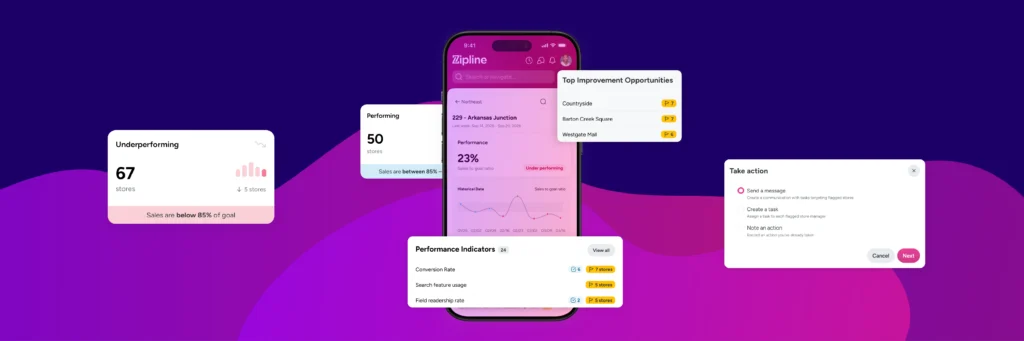
To help leaders go beyond performance metrics and understand what’s really happening at their stores, Nerea and Zipline’s product team have been working to develop ZipCoach, a performance optimization engine that answers the question: what are the behaviors that impact store performance and what should happen next?
Going deep on behavioral signals for the frontline
It’s a version of a question Nerea has been answering her whole career. She trained in econometrics and behavioral economics, combining the study of how psychology and cognitive biases shape economic decisions with statistical methods that help measure and explain those behaviors.
This involves modeling human behavior and “trying to understand and explain why people do what they do,” as Nerea puts it.
After years of studying the theory of behavioral economics, Nerea joined Zipline to go deep on the behavioral signals that move the needle on store performance. And, as it turns out, there are a lot of behavioral signals at play.
“A big part of what I actually do is work directly with customers,” she explains. “We sit down with them and figure out what their pain points are, what their opportunities are, and how we can help with their day-to-day work.”
Oftentimes, the difference in performance can come down to small variables like “what the team does every day, how quickly they read a communication, whether a task gets done at the right time, who’s working on them, when the information gets ingested and by whom, the routines they keep,” Nerea says.
When teams use Zipline to run their retail operations, they can suddenly see and access this data clearly. But that’s not the same as knowing what to do next. Nerea explains that it’s easy to see those things move together, but hard to understand what is a statistically significant set of data points. And, testing the wrong theories about what’s behind a dip in performance can be costly and time-consuming, leading to teams trying to “solve the wrong problem.”
Retailers have more data than ever before, but turning that data into actionable insights that continuously optimize performance across hundreds or thousands of stores, each with its own unique conditions and challenges, is the problem ZipCoach was built to solve.
Creating institutional knowledge with ZipCoach
ZipCoach is a machine learning engine built for each brand and embedded in the Zipline platform. It connects what frontline teams do every day with how their stores actually perform, so teams aren’t guessing or feeling around in the dark.
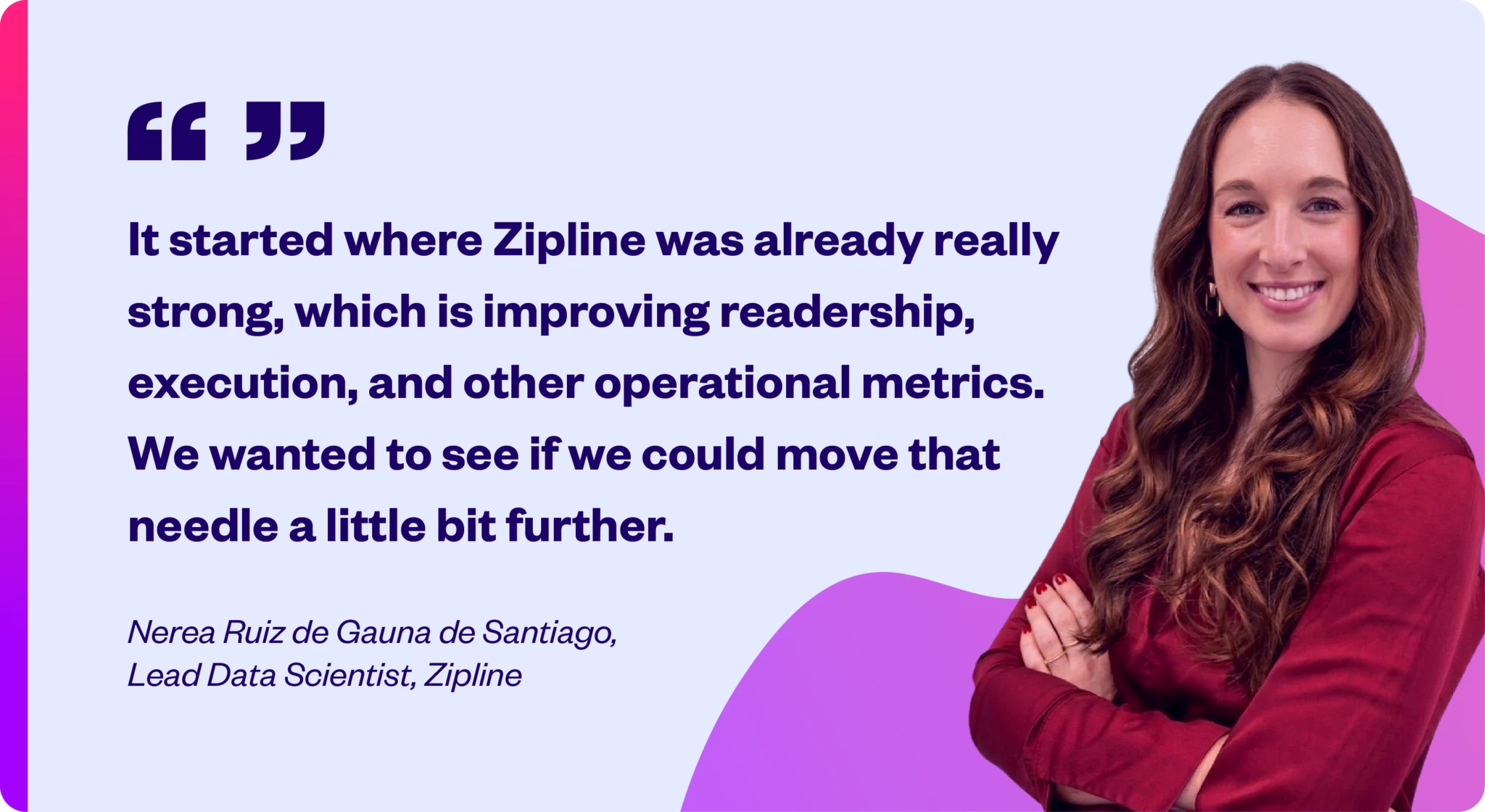
“We started by building on the foundation where Zipline is already really strong: driving engagement, improving execution, and helping stores operate more effectively. With ZipCoach, we wanted to take that a step further by connecting those operational behaviors to business performance and helping retailers understand what drives better results,” says Nerea.
“When we started analyzing the data, you could see that the most important signals were different for each of the brands. […] So, in the very, very early developments of ZipCoach, we realized that each customer needed its own data model, tailored to the unique factors driving performance across their business.”
Unlike traditional dashboards and reports that simply show performance after the fact, ZipCoach goes a step further, uncovering what’s driving results, identifying opportunities for improvement, and recommending targeted actions for each store. As those actions are taken, ZipCoach continuously learns from the results, refining its recommendations to drive better business outcomes.
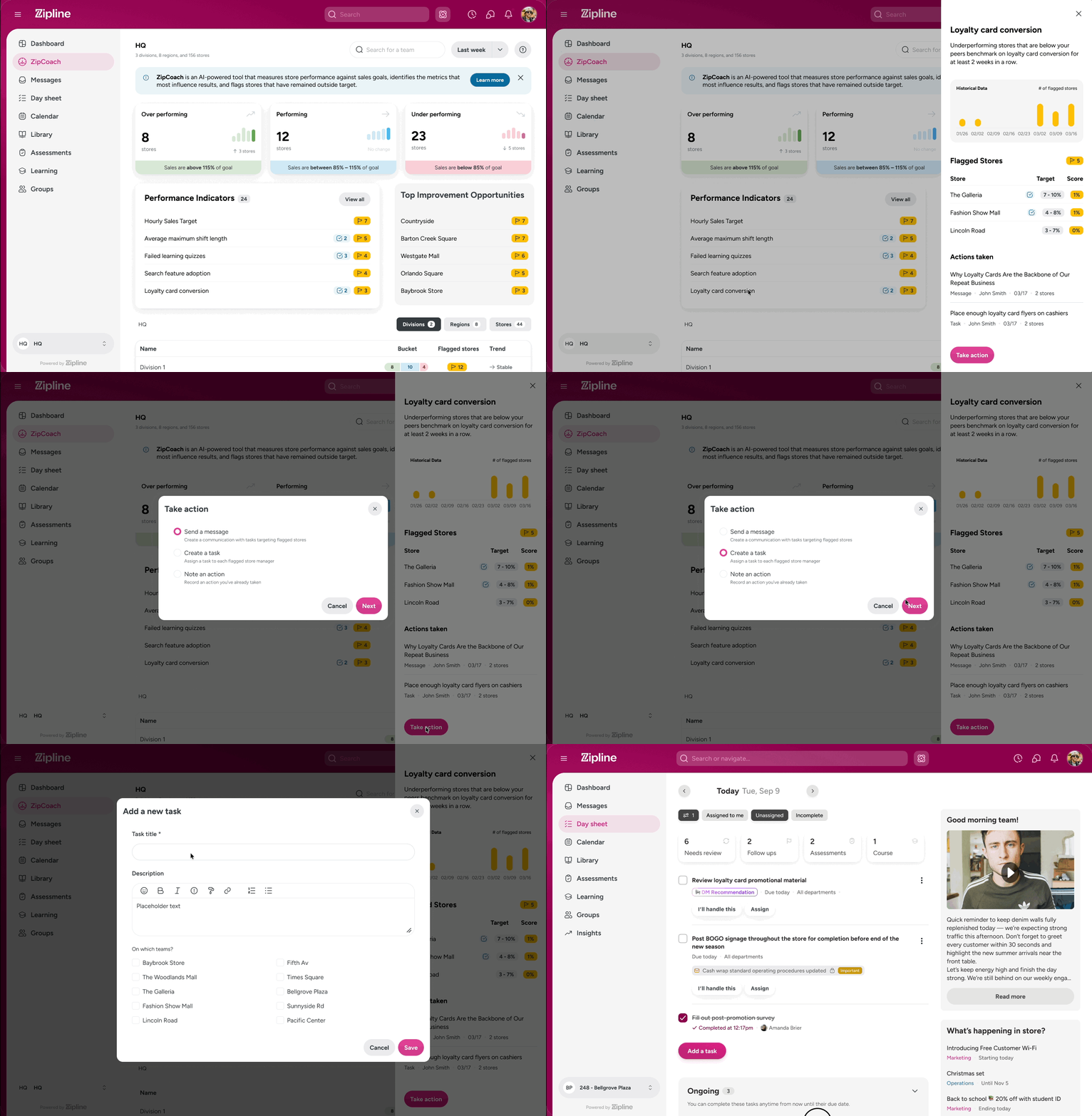
And the recommendations are not based on generic benchmarks. Instead, ZipCoach learns what drives success for individual stores and then makes recommendations based on replicating the behaviors of your most successful peers.
“It will understand which stores are your peers, which stores are similar to you and might benefit from that behavior,” Nerea says. But these aren’t just any stores. They’re “only stores that are similar to yours.”
It’s almost like having a consultant or highly experienced leader with 20 years of retail experience giving your locations actionable intelligence about what to tackle next. Operational knowledge is no longer trapped in a single top performer’s head. And when it comes to understanding what’s driving performance decline, field leaders no longer need to guess.
Instead, they monitor and take action on signals like completion of assigned training, whether stores have the right shift coverage, how consistently store audits are completed, and how engaged teams are with important communications.
“ZipCoach is doing that at scale. It looks at [a] situation, [and says] ‘for this store, this action worked,’ and it creates that institutional knowledge. It makes it available to everyone else.”
Measuring how day-to-day behaviors influence outcomes
The problem with having so much behavioral data is that it can get noisy, fast. Nerea and the team learned this firsthand when they started working on ZipCoach and ran into a measurement bias pattern.
“Tell me how you measure me, and I’ll tell you how I behave,” Nerea says. “That’s one of the most interesting things I saw in the data. Whatever store leaders and field leaders were being measured on, that’s what you would see moving [in] the data. So if a brand measured UPT, you’ll see high UPT. If they measure transactions, that’s what you would see going up. So it’s completely rational.”
Nerea emphasizes the importance of making sure the data isn’t picking up on a behavior or trend just because it’s being measured.
That’s why ZipCoach looks beyond the metrics a store is already being measured against. By examining a wider range of a store’s day-to-day behaviors and their relationship to store outcomes, Zipcoach can learn what is actually driving performance, instead of what people are already being pushed toward.
It’s also why Nerea and the team built ZipCoach alongside customers from the start: to make sure the signals it learns from are reflecting how stores really perform.
Continuous learning with Zipline’s customers
Zipline’s best product ideas often come from working with customers to understand their current challenges.
The partnership with Helzberg, one of ZipCoach’s initial customers, allowed Nerea and the team to go deeper on the data early on and connect the dots between insights and what comes next.
“We shared with them what the data was telling us. They shared with us the context that they have on that data. We brought some insights to them. They brought some insights to us. And that’s where ZipCoach started to click.”
It’s a two-way street that goes back to making sure Zipline users get what they need to do the best possible job each day.
For field leaders, the value of ZipCoach isn’t only in knowing which stores need attention or which metrics require optimizing. It’s understanding which actions they need to take in order to scale the day-to-day decisions that impact revenue and move the needle on growth and operational effectiveness.
As Nerea puts it: “You want to make sure that you’re delivering things that matter when it matters, and you’re delivering true actionable insights.”
This article is part of Trained in Retail, an interview series in conversation with the experts at Zipline building smarter solutions for the next generation of frontline operations.