
For Caleb Buxton, engineering better retail solutions begins with understanding the gap between HQ’s ideal view and the reality for district managers and frontline leaders.
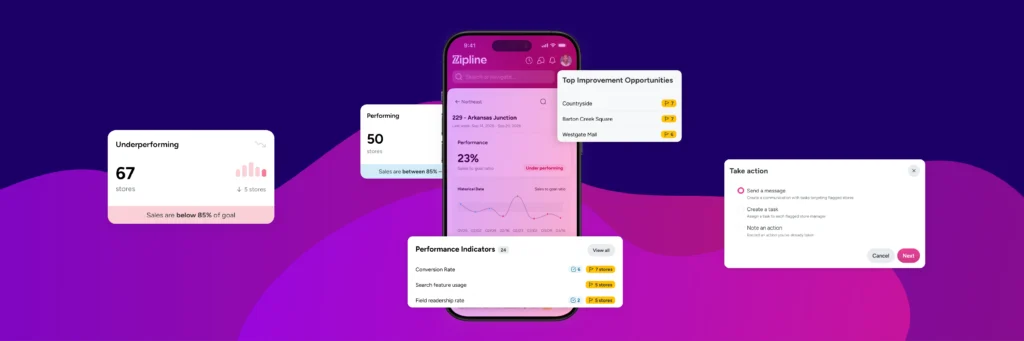
As a senior software engineer at Zipline, Caleb works on the features that help retail teams communicate and execute more effectively across stores. Most recently, Caleb’s work has included Zipline’s AI-Powered Message Summaries, a feature that cuts through overwhelming communications with smart summaries that get to insight faster.
We caught up with Caleb to learn more about how AI-Powered Message Summaries work, the feature development process, and how AI can help district managers get the right information at the right time.
This interview has been edited for clarity and brevity.
Hey Caleb, could you tell us a little bit about yourself?
Caleb: Hey! I joined Zipline in September 2025, and I’m a senior software engineer. A lot of what I’m responsible for is executing on the product roadmap in a data-driven, verifiable way so that I know we are making continuous improvements to the services. That comes from a long history as a software developer, and at a certain point in my career, transitioning to software engineer.
How are you usually collecting feedback and prioritizing new features to build for Zipline’s customers?
Caleb: There are three main channels. First is the account managers — we’ve got a great human touch. Our account managers help with the operations of this complicated software, and through the relationships they have with our customers, they’re providing a lot of qualitative feedback. Then we have a user experience research function with Joe, who works to enable account managers, product managers, and engineers to go into HQ, go into the stores, and conduct user interviews. That’s a very exciting aspect of how we discover opportunities for innovation.
The third channel is the data. We’ve got at least a decade of data over hundreds of retail operations. We can do aggregate analysis over that to see how different users are leveraging the tools.
Let’s zoom out and really focus on the summaries themselves. Talk to me about what they are, who they help, and what larger problem the feature is solving.
Caleb: These summaries are presented as a list of bullets about up to 25 communications. The bullets are meant to capture the true urgency, intent, and actionability of the underlying communications — without needing to read every single one
The problem it’s solving is enabling users overseeing dozens and dozens of stores to understand what those stores are focusing on [and] prioritize where they need to drill in to understand how they’re executing on certain initiatives.

Going into this feature development process, you were probably thinking one thing, and coming out the other end with a refined or changed point of view. Was there anything that was debunked — assumptions you had that turned out to be less of a big deal?
Caleb: We had a belief that the size of content you can get an LLM to summarize was getting bigger and bigger, and that we could just throw it all in and get what we needed back. But very quickly we saw that communications were being dropped from the summaries. So we debunked that optimism and pivoted how we interact with the AIs.
Describe that pivot in how you interacted with the AIs.
Caleb: Once we had identified the problem with early testers, we added in observability. Quantification of what we were putting in and getting out. These are called ex-ante and ex-post signals: what you can know before an AI generates an output, and what you can know after. Now we could see the point at which the AI was dropping communications, and then tuned the generation requests so no single request was going to drop a comm, and then refactored to stream responses back to the user.
Broadly speaking, would you say these summaries make it easier to execute on urgent communications or updates from HQ?
Caleb: Yes — because those urgent communications might be buried under dozens of sweep-the-floor reminders. The value in being able to get a summary out of that is that those dozens of sweep-the-floor reminders should roll up to one bullet point about due diligence for slip-and-fall mitigations. And then the rest of the urgent communications from HQ get the appropriate representation — they can stand out in that crowd of comms better.
How exciting is it for you as an engineer to identify an actual problem, understand how to take it apart, and get to a solution that real people can use in their day-to-day?
Caleb: It’s really exciting to be able to take the latest in technological innovations and turn them into something people can understand and use to change the way they see the world. Before delivering this product, district managers might have been swamped with communications. One of the most exciting parts was connecting with subject matter experts to show side-by-side summaries and communications — is this summary a hit or a miss? When there’s a technology, tool, or technique that can be applied into a new domain that really fits the problem, it’s super exciting to be able to usher in that innovation.
When there’s a technology, tool, or technique that can be applied into a new domain that really fits the problem, it’s super exciting to be able to usher in that innovation. – Caleb Buxton
As AI-Powered Message Summaries join the Zipline family of features, how would you say this feature strengthens the core product?
Caleb: AI-Powered Message Summaries strengthen the core product by increasing the value of logging into Zipline for users. When I look at the distribution of unread messages for upper field users, I connect with that feeling of being overwhelmed. Now those users are going to get way more value out of our communications product line. They can trust that their stores are taking action on the initiatives they’re most concerned about, and then drill in selectively to the activities of their stores to drive the results they’re looking for.
AI in retail isn’t necessarily the most obvious use case. If you’re a retail worker on the floor, how is AI technology supposed to help you be better at your job?
Caleb: On the floor, you’re operating in a really complicated overlap of context. You’ve got all the training you did weeks or months ago that needs to be remembered as you’re helping an anxious customer find what they’re looking for, while also meeting a merchandising or facing task load. What AI is going to be able to help you do is offload some of that context, so you can get the right message at the right time, and know you’re doing the most impactful thing in the scant amount of time you have to try and move the needle on the company’s mission.
Read more about AI-Powered Message Summaries in our Zipline expert conversation series.