Most regional leaders spend their time on their worst-performing stores. The stores most likely to become your next problem are in the middle of the pack, where nothing looks urgent yet. These leaders can see top, middle, and bottom performing locations, but what drives poor performance can come down to a handful of behaviors, rather than a blinking red alarm.
During a recent Zipline event, Ryan Holm, DVP of Retail Innovation and Operations at Helzberg, a retailer with 160+ stores nationwide, revealed a common misstep regional leaders make when tackling struggling or underperforming stores – looking at bottom performing stores when they should be watching the middle of the pack more closely.
In this article, the “middle” refers to any store whose performance isn’t outstanding but also isn’t in crisis. A middle-of-the-pack store is often functional but could not be seen as a leader or as a lagger.
Key takeaways
- The middle is a blind spot: Multi-store leaders naturally focus their attention on their best and worst-performing stores, leaving the middle of the pack vulnerable to unnoticeable operational decline.
- Behaviors precede results: Early warning signs like communication breakdowns, team resentment, or unread messages appear in the middle pack long before showing up in sales or performance results.
- Site visits can be misleading: Short store visits usually showcase locations at their best, so regional leaders should rely on frontline managers and performance intelligence tools to capture true operational culture.
- Coach before issues arise: Proactive store management focuses on coaching team behaviors early to prevent small issues from turning into structural problems.
Why do the best and worst stores get the attention?
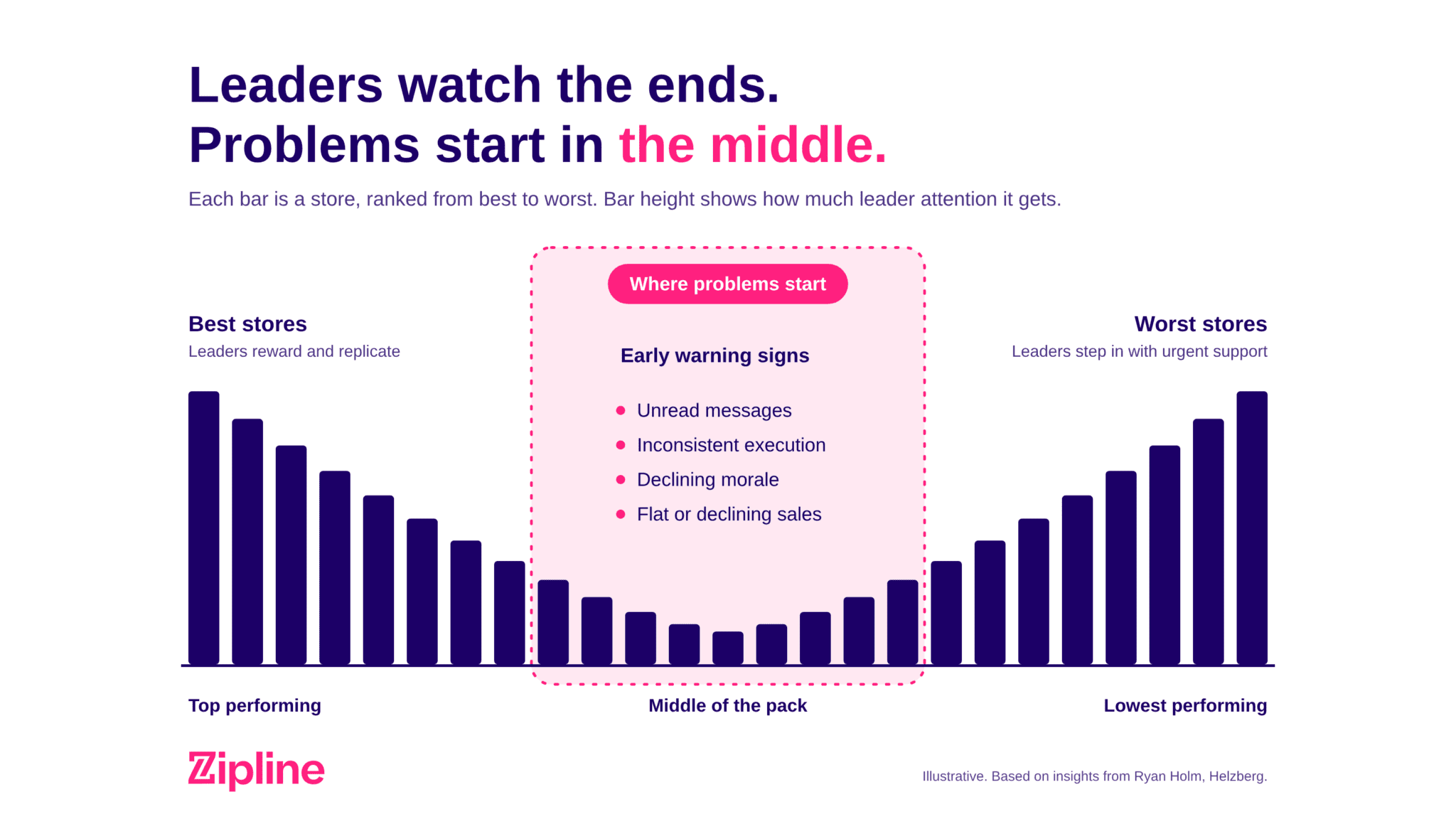
The best and worst performing stores in a fleet often get the most attention because leaders want to reward and replicate the behavior and performance of the best stores and roll up their sleeves to urgently support the worst performing stores.
Holm says it’s common to split focus toward both ends of the spectrum and that the presence of “worse” stores can often require more active intervention.
“I think just objectively, no matter what, you always have a worst store in your region, or a broken store that might need intervention. And,I think the best operators really spend the majority of their time rolling their sleeves up and fixing that, whatever the current worst store is.”
What’s happening in the middle?
In the middle of the pack, early warning signs show up in team behavior well before they show up in results. Holm calls the middle of the pack a common “blind spot” and says, as a multi-store leader, it can be hard to put your finger on what’s brewing.
What’s brewing, however, may be the best indicator of upcoming performance problems on the horizon.
“Sometimes it’s the team that is starting to build resentment for one reason or another,, there’s some sort of critical communication chain that’s broken down, and frustration is starting to build,” Holm explains. “Or people are starting to check out. The team kind of quits reading messages from headquarters because they’re spending their time gossiping about this broken communication.”
It can “take months” for a store like this to get on a regional leader’s radar. By then, small issues have often turned into structural ones that are hard to reverse.
Take a store with ok performance but signals that point to declining morale (unread messages, inconsistent execution, flat or declining sales). Employees with institutional knowledge start to leave and now the location has a staff shortage, less experienced staff overall, a morale issue, and the structural concerns that still haven’t been resolved. That’s how quickly a middle-performing store can become an urgent location to fix.
Why do site visits miss problems in middle-performing stores?
Short site visits tend to show a store at its best, not as it actually operates.
“Of course, when you visit, everyone’s hopefully putting their best foot forward for you, which makes analyzing and assessing that very difficult,” Ryan explains.
But the longer you spend at a location, the culture will begin to reveal itself through the small things. “As an area manager, if you go in and visit for 2 hours, everything can look clean and shiny, and it’s not until you’re there, 6 hours in, and you’re, on your laptop doing something else, and you’re listening to the little side conversations that are happening that you pick up on the culture and what’s really happening in a store.”
Holm recommends leaning on direct reports who are frontline leaders at these locations. He calls them tenured confidants who are going to be able to provide the store level insights for regional managers to catch declining stores early in order to intervene.
Which store performance signals should you watch?
Two things help leaders get middle performers on their radar faster: guidance from frontline managers, and ZipCoach, Zipline’s performance intelligence engine, which decodes dozens of signals each store generates. Put simply, performance intelligence turns store-level data into specific behaviors a leader can coach.
Holm gave two examples of the sort of insights that he’d be watching as a multi-store leader.
Average shift length: “If your average shift length is too high, you’re on your way to burnout as people are working shifts that are too long. […] If you’re over-relying on that full-time staff that’s working overtime, you likely don’t have flexibility to cover those peak segments.”
Store manager engagement: “The second example I’d give is store manager engagement with the Zipline app. The store manager needs to be engaged with our store support center, our headquarters, and if they check out, they’re the main bridge between corporate strategy and frontline sales associates, and we need them being the first to read messages and championing that strategy.”
Store signals to watch
| Signal | What to watch for | Why it matters |
|---|---|---|
| Average shift length (vs. a target range for peer stores) | Too short: over-reliance on part-timers. Too long: burnout and overtime. | Performance issues, plus less flexibility to cover peak periods like Friday evening and Saturday. |
| Store manager engagement with the Zipline app | A manager who is slow to read or champion messages from headquarters. | Store managers are the main bridge between corporate strategy and frontline sales associates. |
It’s the mix of ZipCoach insights, plus exercising operational judgment that will ensure multi-location leaders get the most from Zipline’s performance intelligence engine.
Holm recalls a specific incident where stronger performance was tied to ecommerce messages being sent, a behavior that wasn’t repeatable or particularly impactful. Once they realized that the workflow was being marked as a success indicator (even if the action wasn’t specifically a success), they disregarded that signal, partly because they had enough operational context of their business to know something wasn’t as meaningful as it had been interpreted to be.
Want to hear the full conversation? Watch the on-demand webinar, How Helzberg Closes the Performance Gap Across 160 Stores
The shift: coach behaviors before they become results
Ultimately, the best strategies for engaging middle-of-the-pack stores comes down to being able to support frontline teams and coach behaviors before a store slips into low performer territory. Holm calls this a “holy grail” strategy.
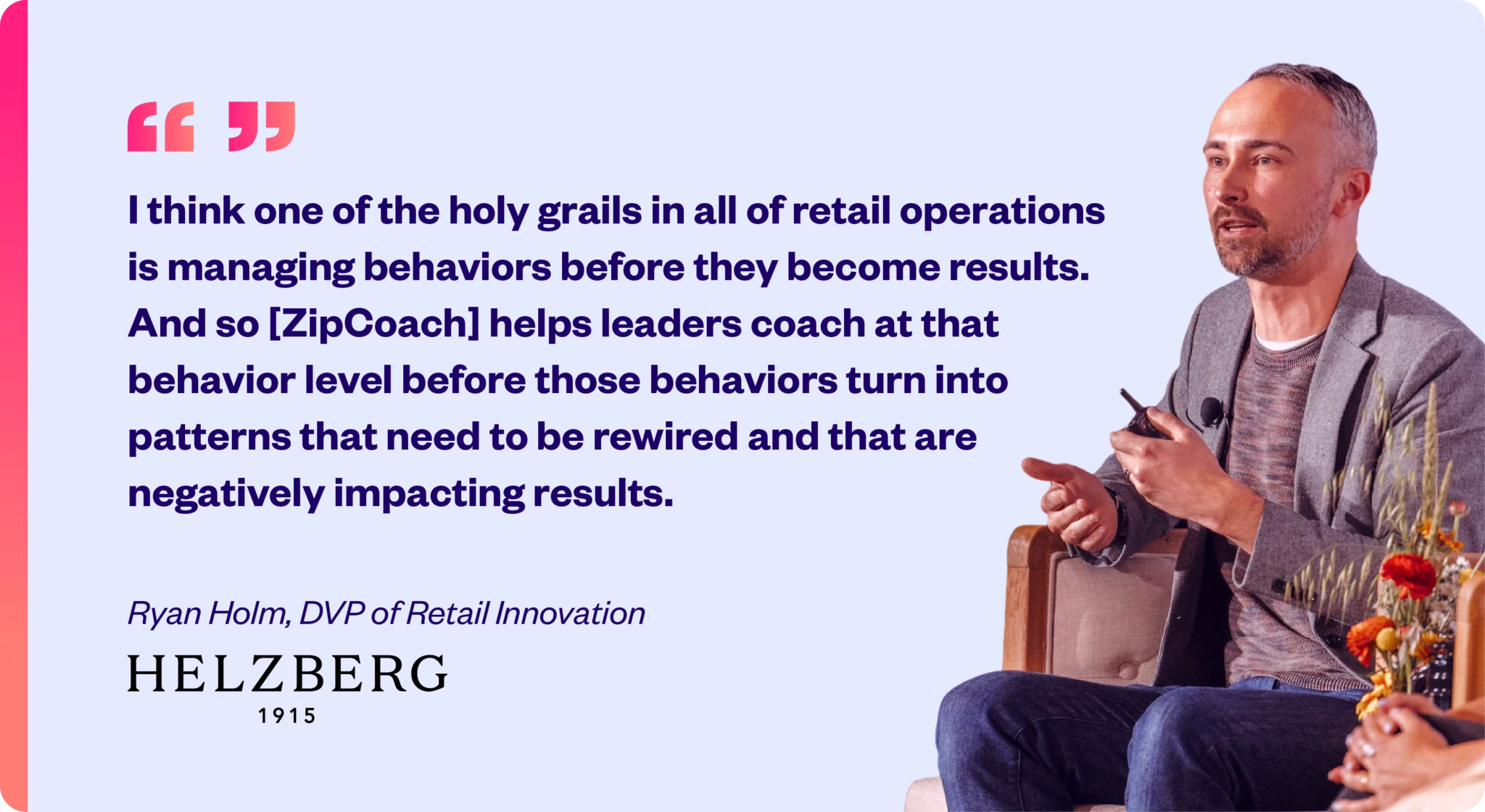
“I think one of the holy grails in all of retail operations is managing behaviors before they become results. And so [ZipCoach] helps leaders coach at that behavior level before those behaviors turn into patterns that need to be rewired and that are negatively impacting results,” he explains.
Holm’s holy grail advice is a lesson in moving from reactive to proactive store management in order to drive winning behaviors rather than correct declining results.
How should regional leaders support the middle?
Regional leaders don’t need to be everywhere. In fact, they shouldn’t be. While it can be logical to show extra support stores in crisis mode, be sure to have a plan for the middle. Work with frontline managers to understand what’s brewing and help these leaders lead by giving them the operational intelligence ZipCoach offers so they can see what impacts performance and revenue and what doesn’t.
The stores in the middle are where behaviors are still easy to change. Reach them before those behaviors become negative results.
Want to find the gaps in your own fleet? Download our field guide Diagnosing Store Performance Gaps Before They Become Revenue Gaps, which covers four areas where stores can actually make changes, plus how Helzberg is using ZipCoach.
Frequently Asked Questions
Why should multi-store leaders focus on middle-performing stores instead of just the bottom?
While bottom-performing stores get urgent intervention, middle-performing stores often harbor hidden operational issues that lead to future performance declines if ignored. Catching early warning signs in middle performers prevents small behavioral problems from becoming severe structural issues.
What are early warning signs of operational decline in middle-performing stores?
Early warning signs include communication breakdowns, unread messages from headquarters, team burnout from long average shift lengths, and declining store manager engagement. Addressing these behaviors early helps maintain morale and operational consistency.
Why do short site visits often miss issues in middle-of-the-pack stores?
Short site visits usually show a location putting its best foot forward in a clean, presentable environment. True store culture and subtle operational friction only reveal themselves during extended visits or through insights from frontline managers.
How does performance intelligence help leaders coach store management proactive?
Performance intelligence tools like ZipCoach decode store-level data into actionable behavioral signals for leaders to coach. This allows regional managers to support frontline teams and correct negative behaviors before they manifest as poor sales results.