

Getting a large enterprise company to agree on implementing a new software solution takes some pro-level cat-herding skills and it’s often not a linear process. Even when it comes to a retail operations platform with features designed to improve store and HQ communications, you’ll still need to bring folks along the journey at all levels of the organization and make a strong case. This takes time and strategy. Fortunately, we’ve got some tips to help you make it happen.
Use our guide below, so you can be the hero who improves store communication and task execution for the whole company…and (bonus!) make your own life easier in the process.
Benefits of a retail comms platform
First and foremost, the execution gap is real and it’s down to a few factors.
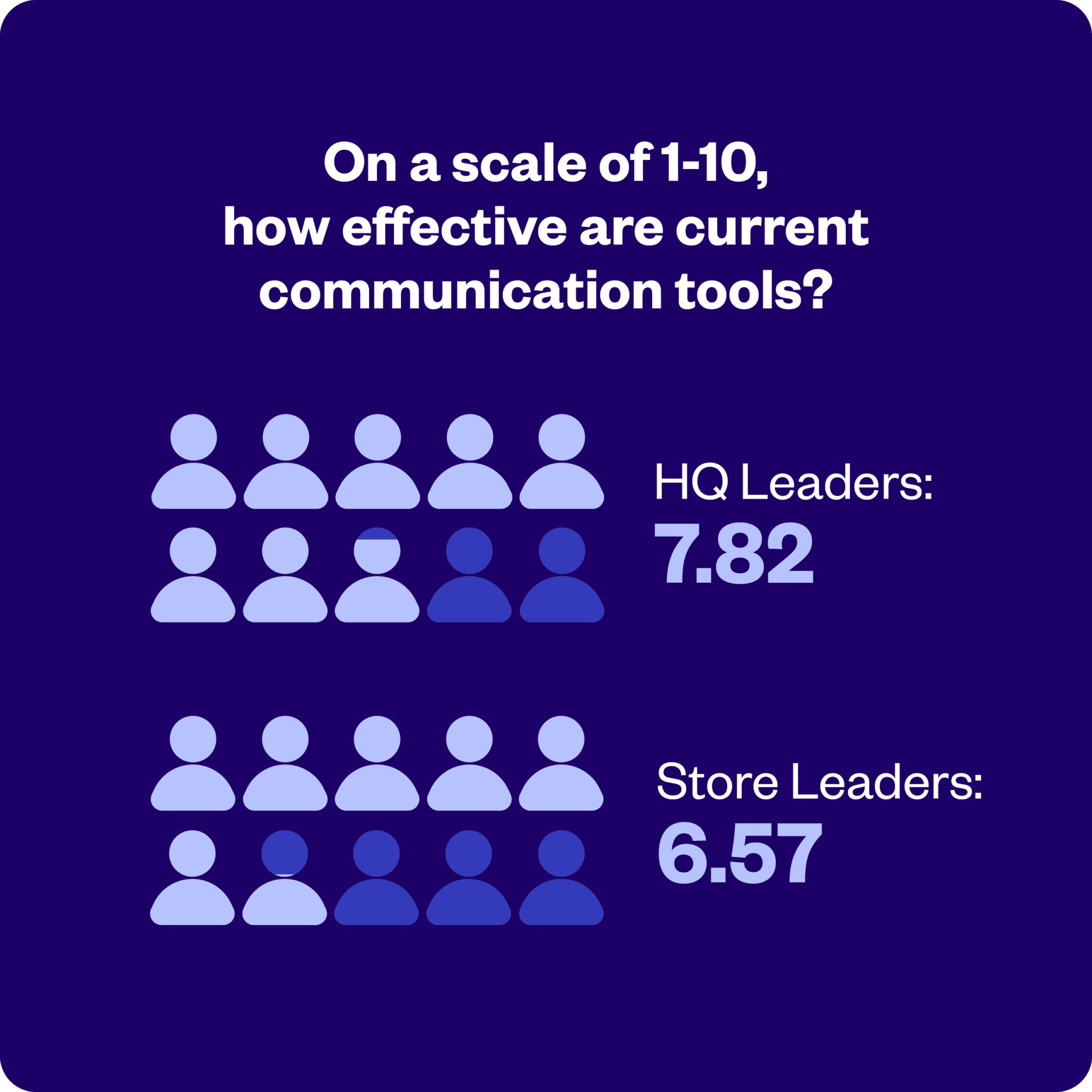
Communication volume, quality, and a lack of prioritization and visibility all signal that teams are defaulting to ineffective communication methods. 81% of store leaders still rely on email as their primary communication method. Meanwhile, store leaders rate the effectiveness of their current communications tools as an 6.57 out of 10.
The job of a retail communications platform is to repair the broken link.
A retail communications platform that truly supports busy frontline teams will provide
- A single source of truth that pulls important communication into one platform
- Visibility into crucial metrics like readership, execution, and engagement
- Ways for leadership to gather feedback from employees
- Clear task prioritization and status updates
So, how can communications teams help persuade their organizations to try a retail operations platform?
Take it to the top
There’s no denying that getting buy-in from top execs is going to get you to “yes,” faster. If you can get an audience with your Head of Stores or Operations, take it. Then, focus your pitch on the points below:
Make it easy. Any new enterprise technology is going to require sign-off from stakeholders and department leadership . Your execs know this, and they probably don’t want to spend their precious free time wrangling department heads for sign-off. Beat them to it. Before pitching a solution, make sure you have alignment from key players in supporting departments like Legal and IT. You’ll need the support of these folks to verify if your top choice complies with emerging security and privacy regulations, and if it will “play nice” with your company’s current tech set-up.
Focus on the bottom line. At the end of the day, your exec just wants to know: “what is this going to cost me?” Find ways to illustrate that your proposal is cost-neutral (or maybe it will even save money!). For instance:
- Arm yourself with industry statistics that show the costs of poor execution. How much do you anticipate this new solution will improve alignment, execution, and sales? What about turnover rates?
- Position as a tool to help consolidate your tech stack. Think about the existing tools you’re already paying for that this solution could eliminate. Maybe you’re already paying for a survey tool, store email, or a document repository — subscriptions that could be eliminated with the introduction of a system that can handle all these types of use cases.
- Quantify the time you’ll get back. Your time is worth something, right? Think about the number of hours you’ll get back in your work week with the help of a communications solution that streamlines a lot of your administrative responsibilities. What else could you be working on, and what’s that worth to the company?
Lastly, do competitive research: Which of your company’s competitors is already using a top-of-the-line communications platform? Who else in the marketplace is winning in your brand’s space, and how do they think about communication? If you make it clear that internal communication can be your company’s competitive advantage, you’re more likely to get the sign-off you’re seeking.
Senior Vice President Store Operations of Loss Prevention and Visual Merchandising at Torrid, Elizabeth Haynes, explained the difference with Zipline.
“With Zipline, our store execution is now above 90%, which is incredible in an industry that hovers around 30%. Our field employees feel better connected to our brand, which accomplishes our goal that messages are being read and actioned by the field.”
Manage the middle
While they might not be the ones to sign on the dotted line, mid-level managers in Store Operations and Field Leadership are going to be your best allies. Why is it so essential that they be brought along on the journey? Because they often have the ear of department heads, and can make or break your campaign for a better communications system.
These “not-quite-stores, not-quite-HQ” leaders sit between two disparate organizations. These are the DMs, RDs, Field Visual, HR, and Operations folks that need to advocate on behalf of their store teams, but also have to help spearhead initiatives on behalf of HQ.
While your instinct may be to focus on those leaders you have the best rapport with, it’s better to start with the ones who will be hardest to convince – the people who show up at your desk on a regular basis to complain about a message that went out without their knowledge. Turn the people you expect to give you the most problems into your strongest allies by focusing on the things that matter to them:
- Remind them that you realize it goes beyond stores getting too many messages. It’s also about prioritization. Tell them you know that when everything looks like a priority, field managers have to spend their time trying to sort out what actually matters most. A solution that prioritizes tasks for them will give them time back to focus on more important things, like improving customer experience and driving revenue.
- Show them how your solution will improve task execution. Store teams will clearly see which messages have priority, what they need to do, when and how to do it, etc.
- Explain real time feedback loops that allow them to see who read which messages and completed which tasks. This will help to optimize communications to increase engagement and execution rates.
Remember: you don’t just want Ops and field leaders to share your vision. You need them to be excited enough to take action, whether that means persuading reticent department heads or answering questions straight from the C-suite.
Grassroots support from stores
You know who hates those 40-page PDFs almost as much as you do? Your store teams. These employees are arguably the ones most impacted by the decision to implement a new communications solution — and there’s also a lot of them! Fortunately, better workplace technology is an easy sell. Here are some tips to unleash store employees as your own personal sales squad:
Send a survey. Before rallying field teams around a new solution, it’s best to get a baseline understanding of where they’re struggling with communications. This will not only give you loads of great data to build a business case, but it will also prime your store teams to think about where communications have failed them in the past (making them even more receptive to a new solution!).
Stores’ time is precious, but you may be able to tag some questions onto a pre-planned survey — like a bi-annual engagement pulse survey. Ask questions like:
- How much time do you spend finding, reading, compiling, and delegating communication every week in total?
- Do you (never, sometimes, always) know when initiatives have been updated/what’s new?
- How much duplicate information do you receive from your DM/other stores?
Help them see the future. A future free of inefficient systems and dozens of one-off emails. Organize a group demo of the product you’re pitching, or (better yet) conduct a small test or pilot with a select team. Either way, get the new tool in front of the people who are going to use it and ask for their thoughts. Not only will your store teams feel more engaged and bought-in, they’ll also give you some pretty valuable sound bites that you can surface back up to the C-suite.
Arm them with information. If an Ops leader or exec is on the fence about your proposal, who are they going to ask for advice? Their store teams. Make it easy for stores to advocate on their (and your!) behalf, by making it relevant to their day-to-day lives. A good way to enable potential internal champions is to give them a few bullet points on how your solution could help with an upcoming initiative or illustrate how it could help Managers rally Associates around a new customer service model.
Closing the deal
When it comes to getting internal support for adopting a retail comms platform, getting the right message in front of the right stakeholders is crucial.
Sell the C-suite on how the right retail communications platform can move goals on both efficiency and task execution in the right direction. Demonstrate the impact it can have on the bottom line. Bring your ops managers along on the journey, so they understand how a communications and task management solution will have a downstream impact on day-to-day in store operations and morale And, last but not least, don’t forget to rally your store teams around a brighter future. Does it take extra work? Sure, but only in the short term.
Once the transition is complete, everybody’s jobs should be a lot easier. Especially yours. Learn more here.